E winches

I would like to ask if any of us have had any experience with

  1. The French made ewincher
  2. The American made winchrite

To be used for sail raising purposes.

Any pros and cons to consider ?

I have watched YouTube videos and read some yachting magazine reviews but would appreciate Any feedback from nonsucher.

I know There is a cost difference but I’m wondering if there are some unanticipated factors to consider .

Helen Dakin
Sailing N33 #7 Sashay
INA member
Kingston Ontario

Hi Helen -

I have gone on record as not recommending the American-made Winchrite. It is not American-made. It was designed in the UK and is made in China using no-name Chinese parts. It offers 810 inch-pounds of torque. IF it breaks (and they do), you’ll lose it for many summer sailing weeks and pay (at last count) $250.00 USD plus ??? … HST, shipping, etc.. You must return it to a depot in the USA. The no-name Chinese battery will be replaced and the unit will be repaired and returned to you. A friend went most of a summer without his Winchrite, waiting for it to be returned.

Performance wise, on a two-speed winch, it should get the sail up to the top … it should, I say. The bigger the winch, the easier time of it for the Winchrite. It just does not look or feel like a quality unit.

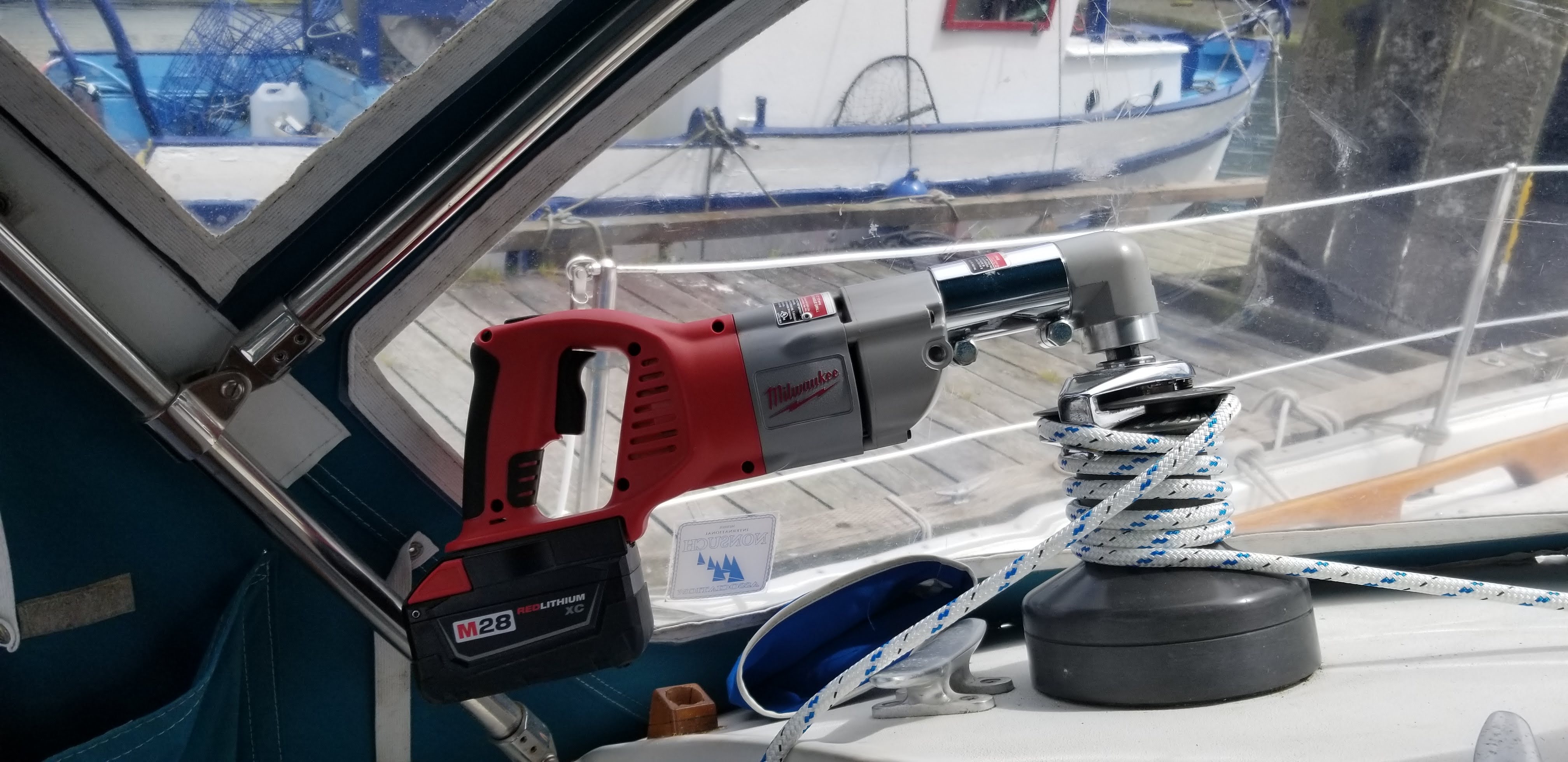
I’ve never seen an Ewincher. They cost the earth but they’ll do the job very well. Did I mention that they cost the earth ?? If you have a good two-speed (very important) halyard winch, you cannot beat a Milwaukee right-angled drill with a Winchbit. These are very tough, high quality tools and, honestly, I don’t think they are bigger or heavier than an Ewincher. They are MUCH cheaper and, maybe, can be bought used (Kijiji, Craigslist). They have torque to burn. It’s all about torque.

My two cents.

Ernie A. in Toronto

Where do you get the winch bit?

What size cordless Milwaukee drill do you use for your 22 and do you have any idea of size would be appropriate for our 33 (we have a 50 ft luff)

Helen Dakin
n33 in kingston Ontario

Google winchbit.com I actually use a smaller Hilti drill. Plenty of torque. Maybe someone who uses a Milwaukee drill (Paul Miller et al) can chime in.

Check this - https://www.milwaukeetool.com/Products/Power-Tools/Drilling/Right-Angle-Drills/0721-21#sp-specs This drill has 1081 inch pounds of torque. Nothing can touch it. It may be out of production, though. Check other good brand names for right angled battery-powered drills (Dewalt, Makita).

Don’t even think about Candian Tire ones. It’s all about how much torque the drill has.

Ernie A. in Toronto

We have used a winchrite on our previous ( much larger ) boat. It raised a full batten main and brought in a large genoa fairly well. It comes with 2 bits and a bit of a carrying case. One limiting factor is our ability to hold onto the handle when the max torque is applied. I read an article somewhere that discussed the speed of the different options too, certainly the winchrite is matched to the sailing application quite well.

Dennis
N26U
Smuggler’s Cove Sailing Club
NOTL

I keep going on about the existing manual halyard winch on the boat. If the winch is a hefty multi-speed winch (say, a Lewmar #40) and it’s relatively easy to crank in slow mode, darn near any drill or Winchrite, etc. should have an easy time getting a sail up. IF, however, like me, you have a bad shoulder AND your winch is a single speed (like my Lewmar ST #16 - oooffff), it is a struggle for me to raise the sail more than halfway, by hand. Hence, my drill.

It’s more about your halyard winch than the piece of equipment that is grinding the winch.

Here’s what I wrote about my drill for our club’s magazine - " A HILTI SF 10W-A22. This is a lightweight Hi-torque (1062 in. lbs.) 22 volt reversing ½” drill. It comes with a 110 volt charger and a fully adjustable handle. The quality is superb, second to none. It is only a drill – not an impact driver or a hammer drill. It is not a right-angle drill (unnecessary for my application as my dodger is lowered and not in the way). It has the very best warranty in the business. The cost WITH the ‘WinchBit’ came to a little less than $500.00 CAD, all in. And, I have one heck of a fine construction drill."

I’ve attached a photo of my drill ready for action. Remember, it’s about the torque. If you find any quality drill with reasonable torque (900 inch pounds +, give or take), it should work.

This topic has come up for endless discussion on this board and i’ve discovered that many of us have had success with all kinds of other drills and the Winchbit. The Winchbit does require a 1/2" bit (or larger, I suppose).

Good luck and due your research and due diligence.

Ernie A. in Toronto

(attachments)

Ive been using the Milwaukee 28v right angle drill for four years now and I’m still impressed. It raises the sail on my 30 in about 25 seconds, switching to reverse for the last couple of feet. Lots of power left over. I’m told the new 18v replacement has as much torque or more but the handle placement isn’t as good as the old 28v one.
The one thing to be aware of with any drill if you have a two speed winch is that in reverse the force is all born by a little Allen screw that retains the chuck on the drill. If it breaks it will be very difficult to replace. The easy fix is to unscrew the chuck and replace it with red Locktite. I went a step further and replaced the chuck entirely by drilling and tapping the bit itself and screwing it directly to the drill spindle with red Locktite.
BTW it will also sheet my sail quickly under full press of wind.

Paul M
NS30U #211, Sandpiper
Cowichan Bay, B.C.

(attachments)


Be careful what you wish for. I have not been tempted by a power winch as it will not detect a problem while raising sail which could result in expensive sail repairs. Instead I chose to relocate the main halliard winch to the position next to the hatch so one can make full use of the two speed gearing when the handle is not hampered by the dodger. Also, I went to a larger winch than the original Barient 19 supplied with my 1981 Nonsuch 26. An unintended bonus is that it gives my 84 year old body a bit of much needed exercise. Anyway, my bank manager is happy that I have not made an investment in an electric winch and my doctor is relieved too as electric winches can result in nasty accidents, if one is not paying attention to both the winch and the sail.

One should not need an electric winch on larger Nonsuches if one has a well maintained Tide track. However, I confess that I have never had to raise the sail of larger Nonsuches and at my stage in life do not intend to start now.

Cheers,

John Newell
Mascouche 26C 1
Toronto

An advantage of either a drill or patent electric “handle” over an electric winch is that you DO get feedback if there is a jam or obstruction. A friend just tore his sail because his power winch gave no warning of the extra strain until too late.

Electric halyard winches should not be self tailing because of lack of feedback. Many a finger or even a hand has been lost - no matter the use.

Joe Valinoti
S/V iL Gatto NS30U #221
Sea Harbour YC
Oriental, NC USA

You were asking for eWincher experience feedback from a Nonsuch user: I have been very pleased with this French made product. It feels comfortable like a common winch handle and can be used manually as well. Like a good winch handle it locks in place and can be left there until you are finished sailing for the day, so there’s no need to ask someone to stow it below every time you’re finished using it. A dock neighbor with a 36’ Nonsuch broke his WinchRite and now has a eWincher.
Herb G. Huber, MISTOFFELEES 30C#91, Bridgeview Marina, Point Edward (Sarnia), Ontario

Mr Huber
Thank you very much for your reply
Might you know whether your dock neighbour with the NS 36 uses his Ewincher to raise his sail? I ask as that is our main need, so to speak.

Given uncertainty as to the repair of our halyard capstan, Helen has ordered an Ewincher but I’m still looking for testimonial as to the Ewincher capacity to raise the NS 33 sail.

Ken Dakin
NS 33 # 7
Sashay
Kingston / CBYC

Hi Ken,
I broke down and installed an Andersen 28 electric winch on MagnifiCat. Best 3 Grand ever.
Handles cranking the main much better than I could ever do, even before I turned 80.

Alan Steward
30C #144 MagnifiCat

Hi Ken -

I truly believe that an Ewincher will easily raise the sail on an NS33 providing your actual halyard winch is a reasonable size (and, likely, a two-speed). A manual two-speed winch, in slow mode (twice the amount of cranking - half the effort - high school physics) should, with some effort, raise any Nonsuch sail. Using a powered winch handle (Ewincher, Winchrite, a drill, etc.) makes the process effortless. Going slowly (in slow mode) makes it a piece of cake for a good powered winch handle.

I see that the Ewincher TWO has 20% more power than the original. Did you buy the new model ??

Ernie A. in Toronto

Here are few interesting Ewincher factory videos.

https://www.ewincher.com/en/content/35-videos

Ernie A. in Toronto

This is Helen here in response to the debate.

There’s nothing worse than a fine Sunday motoring out for a lovely sail only to discover your winch is out of commission and you can’t manually raise that big main. Our setup on our 33 has a barient 22 2speed winch and a capstan behind it which combines to make for simp,e raising of the main with a foot switch up to about a foot from the top of the mast with ken raising it the rest of the way manually.
We motored back to the dock on Sunday and tried to determine the source of the problem and ruled out wiring.

The capstan has done its duty for 34 years. What are the options?
Electric winch?
Milwaukee drill and winchbit?
Winchrite?
Ewincher?

Our barient 2speed winch is superb
If the capstan is replaced with something else electric that will require more holes on deck and quite possibly even more intrusion into the galley above the refrigerator cooler. That space is already imposed upon with the box containing the guts and motor of the capstan which fits inside the box , (doubtful that new equipment would).

We’ve had an incredible response from everyone in the group and I cannot tell you how valuable everyone’s input has been.
Ted Eedson even came down to our boat with his Milwaukee haug and we did a test drive to try and raise the sail at the dock. It was a struggle and while it is a great tool and is quite popular and highly recommended by many 22, 26 and maybe some 30 owners, I was not able to get a confident feeling that it might be used by a 33 or a 36.

The winchrite product seemed to be an interesting option and used by many on the racing circuit. I got the sense that it was primarily used for fine tuning and for shorter time periods.
The mast on the 33 is kinda tall. It takes a while to raise the sail even with the capstan assistance. The capstan works at a nice slow and even pace (when it works), allowing us to keep a visual inspection of everything as the operation is underway. When it slows down, it’s usually for a reason and we have time to deal with it.

The ewincher product was very appealing to me because it looks like a winch handle
acts like a winch handle and feels like a winch handle
Albeit a big fat one with a battery inside it.
It can actually be used as a winch handle too, but if I only needed a handle I think it highly unlikely I would reach for the ewincher.
The weight of the ewincher is about 5pounds which is less than Milwaukee and winchrite.
I watched a lot of videos and read a few sail magazine reviews of this and other options given (YouTube and Google are your friends).

On Tuesday morning before ken removed the capstan from the boat to take it in to someone who “might” be able to resurrect it, I placed an online order for the ewincher. By the time ken got back after dropping off the capstan we received a notification that the expected delivery was this Thursday before end of day.

Mother’s Day may be over but Father’s Day is coming up.
The ewincher 2 (the new and improved model) has more torque and I think better battery.
We are looking forward to trying it out.

Helen Dakin
N33 #7
Sailing “sashay” in Kingston, Ontario
And a member of INA

Hi Helen -

Here’s a link to a chart that shows winch comparisons.

https://l-36.com/compare.php

Your Barient 22 (or 22-39) compares to a Lewmar 40 and has a power ratio of 39:1. That is a beefy winch and running it on 1/2 speed (or slow speed) would, I imagine, provide plenty of power to normally raise your sail manually (provided you could/would/are physically capable of doing so without a power assist).

I find it odd that Ted’s Milwaukee “Bren Gun” didn’t make short work of this task. I am impressed by the Ewincher. I would be floored if it didn’t work out for you and, for what it’s going to cost, I SURE hope it’s a huge success.

Please let us all know and best of luck with this machine.

Ernie A. in Toronto

Helen: Determine if it’s the winch motor or a wiring problem. If it’s the motor, take it to any auto electric shop for repair.

Joe Valinoti
S/V iL Gatto NS30U #221
Sea Harbour YC
Oriental, NC USA

Hi Helen,

I own Nonsuch 33 #8.

We had a halyard winch operational failure on the delivery trip from the winter boat yard to our yacht club last Friday. After a 15 mile trip from the yard to the mouth with the wind on our nose, we prepared the sail to hoist for the 8 mile broad reach to the club. I pushed the winch switch with my foot and nothing happened. I checked the on-off switch at the bottom of the ladder. That was on. I cycled that switch several times. Still no winch action.

We did raise the sail. I positioned myself at the mast. Louise was in the cockpit to take up the halyard slack. Faster than the winch on a good day we had the sail hoisted to 2’ short of full hoist. I returned to the cockpit and used the manual winch to complete the hoist.

I’ll be 70 in two weeks, have two replacement shoulder joints and five fused vertebrae in the middle of my back. If we can hoist the sail in this fashion, most others can too. No need to miss a good sail.

However, I do like the electric winch. The issue was the switch at the bottom of the companionway ladder. That Maxwell assembly has a Lucas on-off switch, Klixon circuit breaker and a pilot light mounted on a plastic plate. The Lucas on-off switch was defective. The Klixon breaker is OK. I googled the part number on the Klixon breaker and the breaker is readily available so if that fails in the future a direct replacement can be made..

My fix was to remove the Lucas switch and replace it with a Blue Seas Systems 6006 panel mount battery switch. A 2-5/16" hole was hole sawed in the plastic panel concentric with the original 3/4" switch hole to allow mounting the new switch. Four screw holes were also added to fasten the switch. The half inch pilot light hole is partially involved in the new switch hole but that light never worked in my experience and is unnecessary. The now oddly placed pilot light hole is not an eyesore as the ladder pretty much hides it.

I never liked the Lucas switch. The Blue Seas Systems switch is far superior.

Joe,

Where does one find an auto electric shop capable of repairing/rewinding a starter/winch motor in 2022?