The safety line works as long as the break occurs below where it is attached to the fixed line going to the masthead. If there is a failure further up, watch out! Mine did. The binnacle took the brunt of the force. I was standing between the binnacle and companionway and received a glancing blow which nearly sent me down below backwards. Fortunately I have a solid scull and was not knocked out. In this instance, it was a failure of a nicopress sleeve that was not crimped sufficiently allowing the topping lift wire to slip through.
When I bought Mascouche, one of the first things I did was to replace the topping lift wire as I was very concerned about the damage a wishboom could do. Please check all shackles and fittings above the safety line as well as the wire or line used for the T/L every spring or when the mast is down.
.
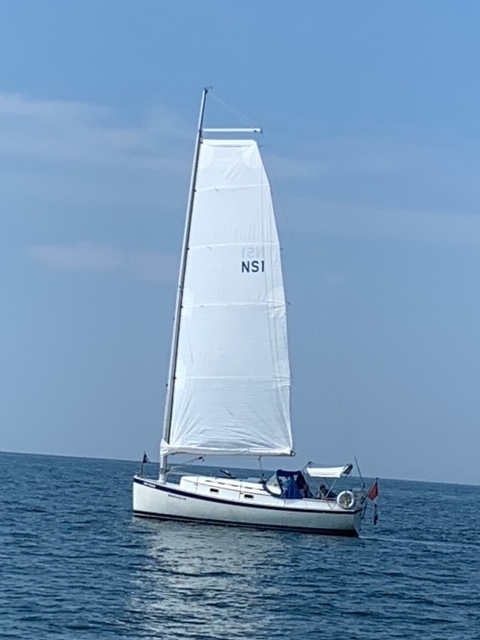
Photo courtesy of Phoenix a Nonsuch 30
I no longer have this worry with the standing gaff rig. The boom does not protrude past the dodger and is supported by lazy jacks and a topping lift. This leaves the bimini as a good safe place to install solar cell(s)
John is correct in pointing out that the safety line is only as good as the fixed topping lift lets it be.
Checking the condition of the topping lift, its attachment point at the top of the mast, and its eye at the lower end, has long been recommended as an important part of routine annual inspection, first by the Hinterhoeller factory, later by its former rigger and long-time Nonsuch parts supplier Mike Quill, as well as the International Nonsuch Association.
Another historical approach is a “roll bar” design developed and sold by an early Nonsuch dealer, Eastland Yachtbrokers, which looks like a particularly well-reinforced aft component of a bimini, and is certainly compatible with being used as such. They’re no longer operating, but it’s not hard to reverse engineer. The design puts a crossbar up far enough forward to catch a dropping boom before it hits anyone.
Regular inspection is by far the cheapest of these three approaches. On the other hand, the others give more satisfaction to those of us who like to tinker on, experiment with, and/or customize our boats.
All shackles should be moused with wire. Some smaller ones do not have a hole in the key but that is easy to do. Stainless is drilled with a carbon bit at very slow speed
 .
.