Deck to Hull Joints

I’ve searched the INA website and the Google Discussion groups but haven’t been able to find information on how the deck and hull are joined (on 26’s particularly). Does anyone have a cross section diagram or explanation? I know someone posted some pics of them laying up hulls in the factory but I couldn’t find those either. Thanks!

Ken Julian
“Blue Note” NS26C#9
Fredericton, NB

Ken,

That’s an interesting question, and although my honest answer has to be, “I don’t know,” my educated guess is that it’s throughbolted at four, eight or twelve inch intervals with quarter-inch bolts through a deck laid flat on an internally flanged hull.

This is based partly on memory from having looked at the connection while in the bowels of the cockpit lockers, and partly from having looked at the shop drawings for the N26 rubrails and toerails.

The rubrails are shaped like a sideways “J” and the curve part lied flush with the hull. That would put the flange on the inside, which fits with being able to observe the bolts and nuts from underneath. The toerail lies on top of the rubrail and is spec’ed to have 17/64" holes at four-inch intervals. The diameter suggests 1/4" bolts and the spacing suggests that the bolting would be done at some multiple of four inches.

Guessing is fun, but if there’s someone who actually knows, that would be more fun.

Hope this helps until someone chips in with a stronger base for their information.

– Bob
Me Gusta
Nonsuch e26U #233

Bob,

Having replaced my entire starboard side rubrail about 4 years ago with Mike Quills last 30-some-odd feet of vinyl rubrail I can attest that your description of the hull to deck joint is spot on.

The rubrail as assembled ran in one continuous piece from stern, amidships, to stern. I only had enough to do one side so there is now a seam at the bow as well as the stern, but I ended up being very satisfied with the job. Speaking of “job,” it was a job indeed. But three very good friends and I disassembled the whole thing in one day during what we called a “fastener party.” Per side there are 80-some-odd sets of SS flat head phillips screws with washers and nuts. Those sets include the fasteners for three chocks per side as well as the Samson post. The layers of fiberglass are just as you described them – inward curved hull with the deck laid flat on top, glued together with a stiff, tenacious silver/gray caulk, with the rubrail laid on top of the deck and fastened down underneath the toe rail. The toe rail itself, an aluminum extrusion, has a bow segment that runs from the Samson post to the chock amidships. (there’s a bow chock in there too). Then there’s another run back to the chock at the quarter. Finally, there’s the stern rail.

I didn’t measure the interval between screws, and I forget the dimension of the screws themselves, but I bet your description is accurate. I do remember, and will likely never forget, the fact that there are 80+ pairs per side.

It’s something you can’t accomplish without help because you need moral support, and you have to have someone topsides to unscrew the bolts while someone down below holds a wrench on the nut.

I will never loose any sleep over the soundness of the hull to deck joint!

Ed Cook

Chat-eau, N26C, 173

Middle River, MD

Thanks for the responses Bob & Ed.

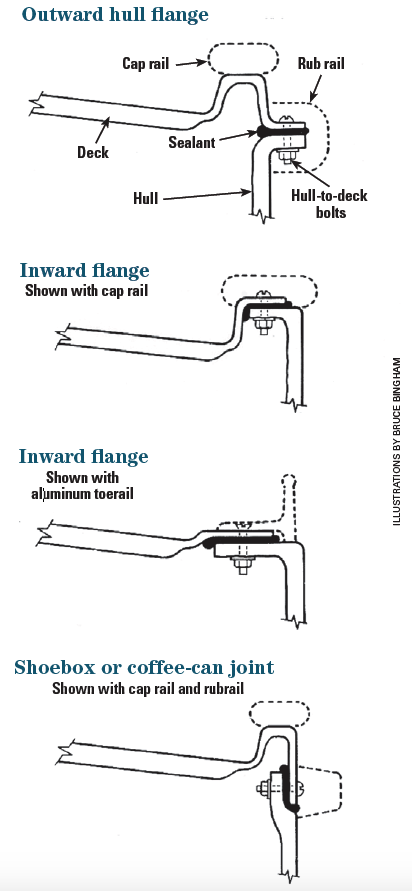
I’m trying to visualize the joint from your descriptions and I think I’m getting the idea. Doing some net searching, I discovered there are many types of joints, but couldn’t find exactly what you have described. In my mind, the 2nd one down best describes what you are saying, but doesn’t have the rub rail that would go on top of the deck section and below the cap rail?

By the way, the reason I’m asking is I’m looking for leaks, and even though I don’t really suspect the hull-deck joint (especially now) I just got curious how they were built.

Many thanks!

Ken Julian
“Blue Note” NS26C#9
Fredericton, NB

Ken,

The second one shown in the illustrations is the design used, but as you noticed it doesn’t show the rub rail.

Ed Cook
Chat-eau, N26c, 173
Middle River, MD

One thing I’ve learned about this subject, is not to over tighten the nuts as it will lead to stress cracking on deck.
Joe Valinoti
S/V iL Gatto NS30U #221
Sea Harbour YC
Oriental, NC USA

The 26 has a solid fibreglass hull (no core). The deck is cored with balsa in some areas, plywood in others and a few areas are solid glass. The area of the deck at the hull deck joint is solid glass. Butyl tape is used as a sealant the the deck is bolted to the hull on 4" centres. Small washers were used backers. It is a good idea to remove the bolts (one at a time) clean out the old caulking, put in fresh (not silicone or 5200) and then attach the bolts with self locking nuts rather than the the nut and lock washer used by the factory. It is a job best done by two people over the course of a few sunny days or under a tarp. There are about 175 bolts and some of them will be close to impossible to access.

Mark Powers

I am getting up close and personal with my rails as the next part of the restoration of Nonsuch. We did about 1400 nm this summer from Lake Ontario to the North Channel in Lake Huron. One of the things that we learned is the plugs in the teak toe rail had become so thin that some screws were visible. Also we had leaks into lockers adjacent to the rail.

Stage 1 - I have removed all of the plugs (around 200, one at a time) and drilled down enough for the screws to be reinserted and new plugs installed. Most of the screws were quite loose, so some leaks were from here.

Stage 2 - Over the winter I will tightened all of the bolts holding the deck and hull together. I did this years ago and it is a slow process to be sure. You can do it with one person. If you have a teak toe rail you do not have access to the bolt heads in any case. You use a small vice-grip to hold the end of the bolt inside the bolt and use a smallish wrench to tighten the nut. The butyl rubber is still quite soft and gooey after 45 years so you do not want to tighten too much. You will quickly get a sense of how tight is just right. I did this with a Niagara 35 years ago. Does take hours.

Ken,

Yes, picture #2 is the best diagram. Across the transom, I think what it calls the cap rail corresponds to the teak piece across the stern. Along the sides, there’s a metal track which sandwiches the J-shaped rubrail’s flat side against the deck, with bolts running through the track, then the rubrail, then the deck, and finally the inner flange. That’s what corresponds to the cap rail in the picture.

The curved part of the rub rail hangs over the side, covering the joint and providing a bumper.

I’m doing this late at night from memory, a few hundred miles from my boat, so Bruce, Mark, Ed or others may need to jump in if I’ve got it wrong.

– Bob
Me Gusta
Nonsuch e26U #233

OK, I think I have a good sense of how it is constructed now. Thank you all. It looks like the only way those joints would leak is for water to get in around the bolts, which might happen more easily with the teak toe rail?

Ken Julian
“Blue Note” NS26C#9
Fredericton, NB

Ken, the only teak cap rail on La Reina is across the stern. The heads of the screws/bolts are accessible everywhere else. I had a small leak along the joint near the fuel cap. Tightening the nuts stopped it. Nesta with with me at the time and she held the bolts still while I tightened the nuts. On another occasion I tried tightening some of the nuts on my own. The bolts turned as I tightened the nuts. After that I had a leak at the bolts. I had to remove them and add some caulking to stop the leaks. The potential downside of using locking pliers to hold the nut as you turn the bolt is that you break the seal around the bolt and will have a leak. It won’t necessarily happen every time but it only has to happen once to allow water in.

Mark Powers

Good to know Mark. Thanks.

Ken Julian

Don’t ask me how it know, but be careful not to over tighten the bolts… stainless fasteners will break.
Don

Yeah, um… just back from NS26C Cat’s Whiskers; was sitting on the settees in the bow section, glass of white wine in hand, and Captain Deb was asking about “what’s next on the work list?” I read through it, and came to the deck/hull joint.

Long story very short - upon explanation, and immediate, short, personal inspection by the captain, she said “is the nut and washer supposed to be at the bottom of the bolt, or at the top?” “If it’s supposed to be at the top against the fibreglass, this one’s about to fall off”.

Ok, maybe this moves up the to-do list a bit!

I think they are 1/4-20NC, but will have to re-verify next time I’m on the boat. And order a bunch of Nylon-insert SS Lock Nuts, if one can find them these days.

JohnS NS26C Cat’s Whiskers, docked in Bath, ON.

John, John, John. Have you actually had Cats Whiskers off the dock this year ? She always seems to be sitting primly at her dock, awaiting the chance to show her stuff. Now I will admit that we have not had MagnifiCat out of the harbour as often as I would like, but we have managed two or three short cruises non the less. Tomorrow, we are off on our fall cruise. A two week voyage through the islands, barbecues on the beach, swimming in warm waters, walking through shady woodlands. Boats are wonderful creatures, they need to be cherished it’s true, but they also need to be worked ! Put away the ‘to do list’, at least until she’s lifted. Take her out and play with her, test her metal in a fresh breeze, bring some joy into her life !; and she will bring much joy into
yours !

Alan Steward
30C 144 MagnifiCat
Loyalist Cove Marina,
Bath, Ontario

Fix it or sail it. The classic conundrum.

If only I had someone who was willing to work on it while I was sailing it, all my problems would be solved.

Well, assuming they’d work for free.

And were competent.

And had all the right parts.

And remembered where I kept all the tools I have.

And brought all the ones I don’t.

Sigh.

– Bob
Me Gusta
Nonsuch e26U #233

Al - Sigh. We basically live-aboard during the season. It’s 5+ hours round trip between home and the marina. Life’s tough, let me tell you. We get the multi-million dollar view without the cost of having to park the Rolls off-site. And, we get away from our winters living close to the epicentre of Canadian Politickin’, and Convoy partyin’ and all that goes with it.

I think last summer we were “away from home base” for 8-10 weeks; this year, only as far as Trenton to the west and the Thousand Islands to the east. e.g. 6 nights partying like 60-year-olds in Picton all told so far this year. Smoke warnings, either no-wind or tornado warnings, hail and house issues (fortunately, house missed the tornados by a few kilometers again; Poor people who got hit, though) meant that our around-lake-Ontario meanderings didn’t happen this year, but so what? Just being on the boat is an absolute pleasure, even though most of the time we are the one or two overnighters at the quiet marina, and it is an absolute pleasure to go and help fellow Nonsuchers get back on the dock after their immaculate sail. Gosh, recently a fellow Nonsucher even called me “Captain Stewart”, which caused me to puff my chest out most proudly! Most of the boats just sit there, collecting spiders and bottom-growth. Taking off mid-week for a quiet anchorage or mooring is better, but one then misses the “Duelling Discos” and the “Disco-dancing-slip-n-splash” from the weekend party-boats. Such is life.

Captain Deb loves her re-worked hot-water, and her new stereo system (replaced the old cut-out-all-the-time '70s one - from the “bad-old-days” that kept cutting out when my techno-music was played, but Deb’s country went through no problem?? must have been the thumping bass, versus the Country vocal squeal, that jittered the vacuum tubes) and the solar allowing us to stay out for nights on end, and the new-this-year refrigeration, all of which is great! Especially not having to carry jugs of water “home”, and trying to find ice that is not already melting for the ice-box, like in past years. Working water and refrigeration is a thing of wonder.

It’s tough liking to both sail and work on things. I mean, boozin’s ok, but I try and abstain between 6am and 11am so doing other things like trying to figure out why a choker is called a choker by twiddling the line (whichever one it is - maybe you know??) and working on things like my spelling and why we called our dog YoYo and boat electronics passes the time. Working on things gives one unique knowledge, like, well, like that needle-nose pliers are a multi-use tool, that can not only remove nose hairs, but can and help with things like, um, other things like, um… well, Paul Miller will jump in here and tell us both. I also know that Electricity comes from more than lightning and from match-cruising between Mark Powers and Thor Powell; I was made mention in Good Old Boat by helping a fellow boater, from Rochester, in difficulty in Trenton, with something electricity related. Ok, it’s not Yachting Monthly or GQ, but I’ll take the Good-Old-Boat mention anyway, and it did show that us Canadians are not all beach-bums in Florida to our fantastic friends south of us.

We both know that working on the boats off-season is hard; Deb finds the cold hard on her Rheumatoid Arthritis (that’s very true, sadly), but I think I might know who to call on, who lives close by, who has a Nonsuch 30 and needs the increased exercise that shoe-horning himself into the tighter quarters of a 26C lazarette locker will provide, when the time comes to get all 1,780 deck-holding-together bolts (or whatever the hellish count is) re-bedded and tightened!

Fortunately, the Nonsuch Members List has your home number listed…

Nice to see you a few days ago! - John.

To all the others on the list:
John Stewart
NS26C, no growth on HER bottom, Bath, ON.
John, I think the technical term is deck holding thingies.
I hope you realize that as an honourary member of the NNNW Association you are entitled to use Pacific Time so the restricted hours can be circumvented.

My eight track has no problems with 70s tunes. I am having trouble finding anything newer in that format.

I was out hunting, I mean cruising, in the Gulf Islands for 7 weeks this summer but the only time I saw Mariner’s Cat V she was tied to the dock at the rendezvous. I guess Thor got tired of holding back so we could keep up so not much electricity here.

Mark Powers

Dear Captain Stewart, John, if I may; your eloquence leaves me speechless. Well it is 6:30 a.m. and the Admiral is firing instructions while loading the land yacht with more comestibles for me to find storage space for aboard MagnifiCat. As she appears already in danger of sinking from being over laden I do have some concern ! However, sail we shall, with a wave of goodbye as we leave on our adventure. If you’re crammed into the starboard lazarette, dropping nuts and bolts into the bilge as we pass, I’m sure Deb and Yoyo will pass our farewells down to you.

Alan Steward
30C 144 MagnifiCat
Loyalist Cove Marina
Bath, Ontario

The teak rail refit is done and the teak refinished - two coats of Epifanes 2-part clear, followed by one coat of Epifanes varnish which is sort of sacrificial so you can refinish without disturbing the 2-part coating. Have started with the bolt tightening. This is much harder with a teak toe rail since you do not have access to the bolt heads and have to do everything from inside the boat. The joint is in much better shape further aft, I guess there is less twisting of the boat there. Now working port side forward of the galley above settee. A couple of nuts had fallen off - before our ownership since they were not there. Several nuts could be turned by hand. In some cases you can just tighten the nut until you feel that the butyl bedding compound is under pressure. I am using a pivoting, ratcheting wrench which is much better than a regular wrench. Sometimes you have to put the little vice grip on the bolt below the nut. At times, having another joint between elbow and wrist would be really useful.