I am thinking about getting a Nonsuch. Have there been many mast failures? Wer they mostly in the early years-teething problems or r they occuring now due to metal fatigue
Do mast failures occur? Yes. Are there many? Probably not.
In the last few years I had a failure at the joint on my 33. The top section failed by cracking from one of the splice holes.
I had the mast inspected by a rigger in RI with a clear bill bill of health prior to purchase of the boat. The mast failed in strong breeze about three years later.
The insurance company paid for a new carbon fiber mast.
I know of a 36 in my area that had a crack in his mast. His insurance company paid for a new aluminum mast.
Have the mast of the boat you are going to purchase inspected by a qualified rigger. The areas to inspect closely for structure are near deck level and at the joint.
Go to MQYR.com for more info.
Ward Woodruff
N33 #8 Margery
Niantic Bay, CT
Martin,
This is a very common concern; I remember worrying about it myself when I bought my first Nonsuch. No one, of course, can offer a 100% guarantee.
However, there’s a lot of material available that made me comfortable enough to have bought two of the boats over the years. And I’m not a rich guy who can afford to have problems.
Most of the problems were indeed early years teething problems, and virtually all of the risks can be managed by doing a careful inspection of the particular boat you’re considering buying.
I’m aware of people who’ve expressed concerns about metal fatigue, but I’m not aware of any cases where a mast has actually worn out, so I don’t know of any evidence to support those concerns.
Most of the actually observed problems were the results either of corrosion, or of cracks emanating from holes drilled too close to the deck because the greatest forces on the mast are where it passes through the deck. Careful inspection of the mast can usually detect situations that have not already been remediated. In the cases where problems have more recently been found, it is not automatic that the mast has to be condemned; in a number of cases, repairs can be effected. The INA website at www.Nonsuch.org has pointers to factory guidance on these issues.
As Eric Sponberg, a very famous and well-respected boat designer pointed out, we no longer worry about airplane wings’ safety even though early planes needed stays. You can get a lot of information from his very enjoyable web site www.ericwsponberg.com and, as he points out in a now 40-year-old article for the Society of Naval Architects and Marine Engineers, *“*The engineering calculations required for a free-standing mast require, basically, cantilever beam theory [which dates to the 1700s]… For free-standing aluminum masts made of aluminum, therefore, the engineering is fairly simple.”
There is a good article on freestanding masts by Rob Mazza in the Sept/Oct 2020 edition of Good Old Boats Magazine that is worth reading about these concerns. The key paragraphs from it tell you the risk factors to look out for (which, again, have long ago been remediated in most cases). It reads as follows:
Fatigue loading becomes especially
problematic when there are holes drilled in
the lower section of the spar. These holes
introduce stress concentrations—or stress
risers—that can result in fatigue cracks that
then emanate from the holes, especially if
they have rough edges or sharp corners.
A number of early Nonsuch spars failed
due to this problem, with fatigue cracks
emanating from either the hole drilled for
the mast tiedown pin at the mast collar
or from the halyard exit. The fasteners at
the mast splice were another source of
problems, requiring a variety of remedies.
Designers eventually figured out that
the solution to fatigue failures involved
avoiding holes in the mast and ensuring
the mast wall thickness was sufficient to
extend the fatigue limit. It took a while and
involved the redesign and replacement
of a lot of mast lower sections, but now
aluminum freestanding rigs can be assured
of many years of service.
Ultimately, the Nonsuch adopted
carbon-fiber masts that had their own
stringent requirements for the fastening of
hardware and drilling of holes.
Going back to Sponberg’s analogy to airplanes, what Mazza is describing is similar to the early teething problems of high-altitude aircraft. One of the first high-altitude commercial airliners turned out to have fuselage failures resulting from pressurized cabins blowing out. It turned out that it had rectangular portholes at all the passenger seats. Lesson learned, no sharp corners. All your planes have rounded windows, and no one worries about this problem anymore.
If you’re thinking of getting a Nonsuch, you can get a lot of information from the INA booklet, Advice for Potential Buyers, which can be found by going to the INA INFORMATION tab at www.Nonsuch.org, and clicking on (surprise, surprise) ADVICE FOR POTENTIAL BUYERS.
You can also get information on the best practice set-up for ensuring that future problems are avoided by looking at the website of the former factory rigger for all the boats, Mike Quill, at MQYR.com By the way, if you join the INA, Mike is on contract with the Association and will answer member questions about the boats at no direct cost. He often has records specific to individual boats, in addition to more detailed experience with, and knowledge about, their set-up than anyone else around.
The last mast failure I heard about on the discussion board was one of the carbon fiber jobs several years ago, and that’s the only one I recall being reported in the almost seven years I’ve been observing. I see that Ward Woodruff posted while I was composing this; his mast was the failure I’m referring to. His short and pithy advice looks pretty close to my long-winded essay here. And, let’s note, his problems didn’t discourage him from continuing to sail a Nonsuch.
– Bob
Me Gusta
Nonsuch e26U #233
Martin: If you tell us where you are, you might get an invite to talk to an owner in person.
Joe Valinoti
S/V iL Gatto NS30U #221
Sea Harbour YC
Oriental, NC USA
Masts on any sailboat need careful inspection. It amuses me no end that most survey’s do a cursory inspection of the mast and engine and spend most of their time tapping hulls…
Hire a rigger to go up and look. Test the engine oil . Applies to all sailboats.
Another thing that could contribute to mast damage which in turn could contribute to mast failure is chemical or electrochemical corrosion. Our masts have internal wiring, which must remain fully insulated from the mast. All fasteners going into the mast need to have an anti seize insulating compound applied.
The base of the mast and its fixture are in an area near the chain locker. My opinion is that nothing should be stored on or around the base of the mast. Wet anchor rode, chain, especially galv. chain in this area could cause extensive damage. Spare lines, PFDs, rags or whatever can help hold moisture and create a corrosive environment . This area should be kept clean, dry as possible and have good air circulation.
The mast and all its components should be rinsed regularly with fresh water and kept clean as possible. Don’t discount bird droppings. They contain uric acid and pigeon poop has contributed significantly to bridge failures.
Keep things isolated from electrical current, don’t create a corrosive environment, clean and inspect regularly and a Nonsuch mast will last a very long time.
Don Mc
NS 22 #16 “CHEERS”
Puget Sound
This is my chain looker and it shows the barrier at the bottom to keep the chain separated and in place.
Joe Valinoti
S/V iL Gatto NS30U #221
Sea Harbour YC
Oriental, NC USA
[details="(attachments)"]

[/details]Little insurance suggestion - if you get a rigger to inspect your mast, go the extra mile and ask for a written report and supply it to your carrier when you get it.
Our club owns a Colgate 26 and supposedly had the rigging inspected three years ago, but did not receive a written report. We lost the mast over the summer when a chainplate gave out. Since we could not prove the rig was inspected (and the rigger who supposedly did it went silent), our claim was denied - failure to inspect and maintain the chainplate.
Best to document work so that you can easily prove it if the worst happens.
lloyd herman
Rendezvous, 30U
Port Washington, NY
Good suggestion, Lloyd!!
Joe Valinoti
S/V iL Gatto NS30U #221
Sea Harbour YC
Oriental, NC USA
The members of this site r amazing. Thank u guys (and gals?) for all the thoughtful responses. I will get an inspection. ONe of the boats I will be looking at had a survey but his comments on the mast were superficial and vague. Do most riggers understand the unique issues of an unstayed mast?. Bye the way I am located in Nassau County on Long Island
Neither the rigger who looked at my boat prior to my purchase, nor the one who I explicitly asked to do a complete inspection of the mast prior to re-stepping it after trucking, found either of the three problems it has: the cracked fairlead collar, rotated fairlead collar, and some minor corrosion around most of the stainless mast bands and the tack collar. And, while I have receipts and my written instructions to that second rigger, I did not get a written assessment of the mast from either of them. I really wish I’d read this advice before I made that mistake!
The first of those two riggers was very well acquainted with Nonsuches (and with my boat). The second was one of the highest recommended riggers in San Diego and has worked with just about every kind of rig imaginable including unstayed carbon fiber masts, but had never worked with a Nonsuch before mine. And neither of my problems is Nonsuch-specific. So in addition to getting the written report, you might want to do your own inspection alongside the rigger that you do hire.
I’m going for a whale-watching sail on Friday with a friend and then he will help me start stripping the lower part of the mast on Saturday… Cross your fingers!
Martin,
You’re right: us guys and gals r amazing and thoughtful.
Good news, bad news answer to whether riggers understand the unique issues of an unstayed mast:
-
Bad news first: no, probably not.
-
Good news: they don’t really have to. Get one you regard as responsible, and who is willing (as Lloyd suggested) to put their findings in writing. Tell them to inspect the mast and wishbone (especially at the hanger lines from the mast) for signs of cracks or corrosion with particular attention to holes and bolts in the first five feet above/below the deck and at the mast joint. If your candidate rigger doesn’t give you confidence that they can understand THAT and do it for you, then I’d urge you to look for another rigger anyway.
New York has over three dozen INA members, so hopefully you’ll hear from some now that they know you’re in Nassau County on Long Island.
– Bob
Me Gusta
Nonsuch e26U #233

For what it is worth, I have the original mast on my 1981 Nonsuch 26. It has the upgraded s/s bolts at the joint. The original ones were aluminium. A few years ago I converted her to a standing gaff rig with a gaff sheet. The unintended consequence of the new rig with the gaff sheet is that the mast does not whip about which could be a source of fatigue. I hope that my mast outlives my sailing days now that it remains stable in all conditions.
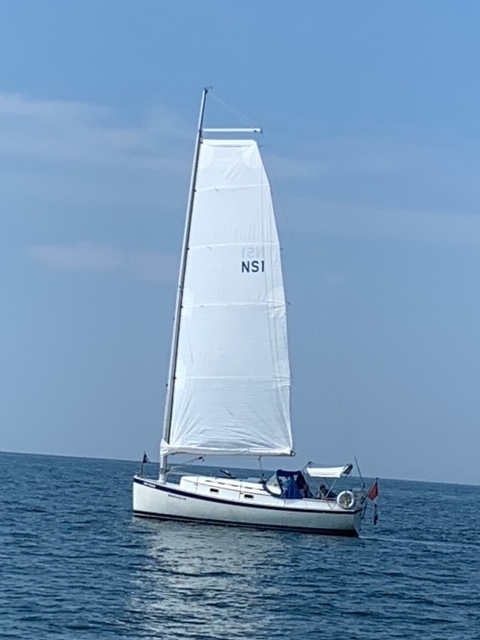
Anyone wishing to eliminate the mast’s tendency to whip, but not change the rig should consider adding a backstay attached to a bumpkin to clear the sail and boom. A crane at the top would help too.
John Newell
Mascouche 26C 1
Toronto
PS This photo was taken when the temperature was 100 degrees F on Lake Ontario and only a whisper of a breeze as witnessed by the ensign.
Mast movement or whipping will accelerate cracking. However, my impression is that the aluminum masts (once updated to factory guidelines based on early lessons learned) are sufficiently well-engineered that this will happen only if the root causes are at work.
I.e., I’m not aware of concrete evidence that a well-maintained mast is at risk of failure simply from usage alone in the absence of root cause risk factors.
By root causes, I mean corrosion and/or improperly shaped or located holes in high-load areas. It may be that these were not caught prior to failure, but my impression of all the cases I’ve been exposed to so far is that they were identified as present.
The one exception to my knowledge is a report of a Nonsuch stored on the hard with mast up during a hurricane with 200 mile per hour winds. Under those exceptional conditions, it is not totally surprising that the mast failed – as many conventional rigs have under similar circumstances.
If anyone is aware of comprehensive evidence (e.g., documented cases, engineering analyses, or failure testing) to the contrary, please get in touch.
As with both ours and conventional rigs, inspection and preventative maintenance are the best protections.
No one can guarantee with certainty that nothing can go wrong, whether with our rigs or anything else. All we can do is evaluate the data, exercise due diligence, pay our insurance bills, and go forward.
The above is my personal opinion, based on the information currently available to me, and does not reflect the position expressed or implied of any organization with which I might be associated. (A statement which reveals that I’ve worked in a bureaucracy or two in my day.)
– Bob
Me Gusta
Nonsuch e26U #233
When I bought Nonsuch, many of the bolts on the mast were either loose, or in a few cases the holes were stopped. I took the bolts out one at a time and replaced each with the next size up. This involved drilling with the correct size drill, tapping the hole and installing the new bolts with Loctite. Took several hours and did not cost very much, great for my confidence in the mast.
My understanding of fatigue is that the problem is not at the top of the mast. The moving around there is coming from forces much further down the mast. I think the join might be the worst spot since the mast loads and unloads there a bit with every wave and wind puff.
Damned auto-correct. Not ’stopped’, but ’stripped’
Interesting side bar. 2019. Hurricane Dorian 200 mph winds for 2 days Abaco Bahamas almost every boat in the yard was tossed 2 Nonsuch 30s where there. NIETHER ONE. Went over one had its mast reshaped - new camber to it. The other also hand its mast bent from the prolonged 200 mph wind. It then failed at the deck where the SS ring with Allen the sleeves are In this case the bend is in the top 35 ft. Luckily strait back. Out of plumb 6-8 inch’s As I speak the mast is being sleeved 6061. T 6 50 inch sleeve (25up / 25inch down)
To be sailed again.
Steve Foose. Jules Verne C30 #428
Green Turtle cay Bahamas.