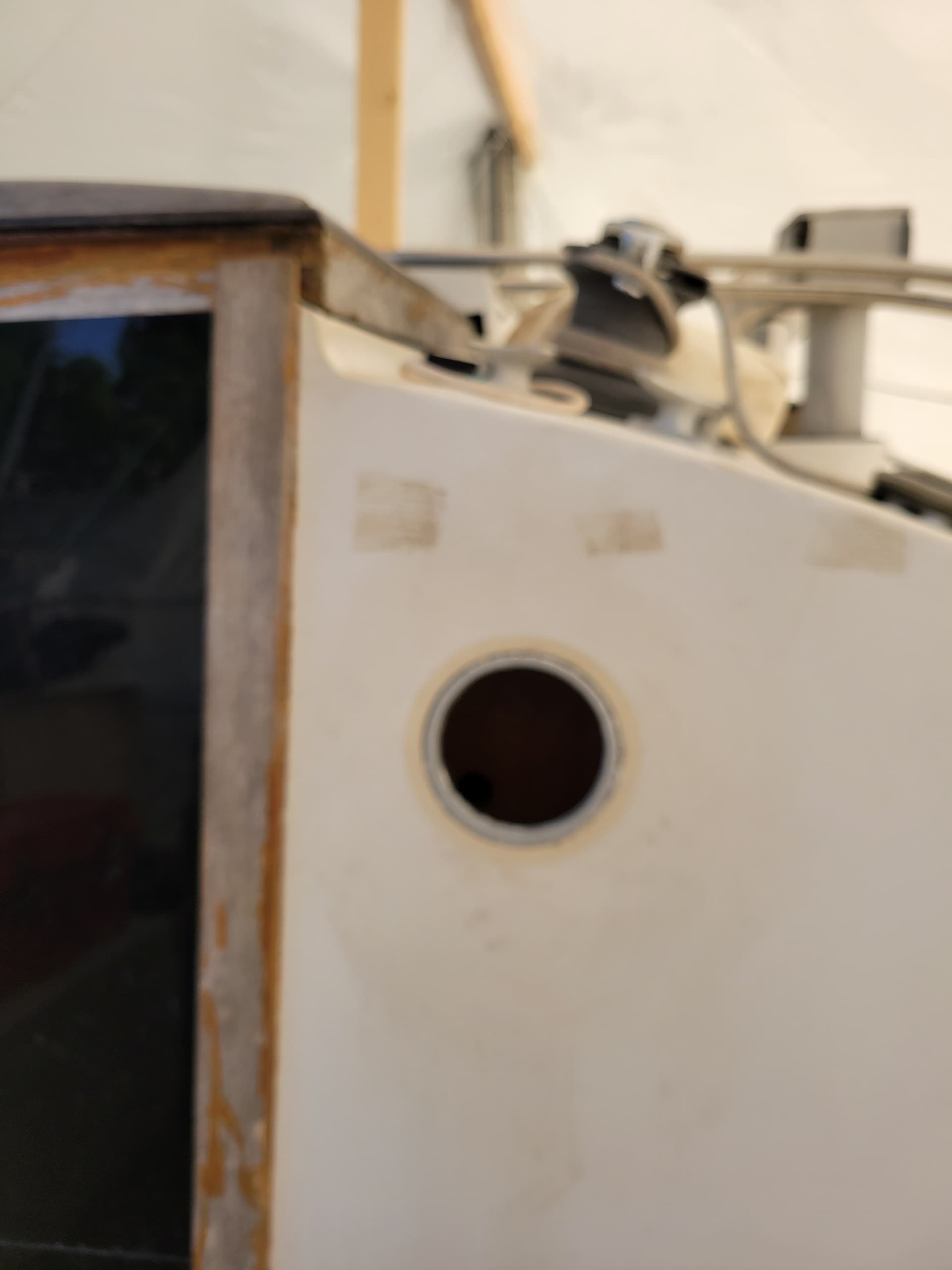
My old Datamarine depth transducer/instrument has become flakey and I want to replace them with a Raymarine/Airmar pair. (I know about the slight diameter size difference and how to address that.) I though I might as well do the speed pair as well.
I am stuck at step one - removing the old transducer - actually step 0.5 - removing the nut on the transducer shaft. An 8 year old discussion thread here talked about cutting the flange off on the outside of the hull, but I hate the thought of taking a sawzall to the hull (especially on a slight curve and with my skill level).
I was able to get a wrench around the slightly more accessible speed transducer nut and with some force move it a tiny bit, but the whole thing - nut and shaft - moved together. (Yes, it was sprayed with WD-40 for a couple of days).
Any ideas short of drilling a couple of new holes in the hull?
Most sawzall blades have offset teeth. This causes scoring if you try to slice on a tangent like this. What you can do to reduce it is lay a file on a table or bench and then rub one side of the blade back and forth and file off the teeth on that side. Think ahead on how you need to hold it while cutting so you file off the teeth on the correct side! (Or make two blades, with teeth filed on opposite sides so you’ll have options.) There may still be a little scoring if you aren’t careful, but it should be much better than using the blades out of the box.
There are also manual handles for sawzall blades which will be slower, but might give you more control and confidence. They may also get closer to the hull, giving you a better angle for making the cut. Here’s one on eBay that looks like it should be narrow enough to get nice and close to the hull. Catcher Saw Handle - CMT JS001 | eBay
Finally, you could use a hacksaw blade, file or sand off the offset teeth on one side, then wrap the ends with duct tape to make protective grips on the ends of a flexible saw blade which can conform to the curve of the hull.
There may be a better way to do it, but these are just my responses to your mention of the fear of using a sawzall next to the hull.
Often thru-hulls have an interior pair of notches that a properly-sized tool can fit into which hold the thru-hull so that it doesn’t rotate with the lock nut as that nut’s turned with a standard wrench.
In other cases, it may be the reverse – the thru-hull has small protusions that a notched tool fits.
Look for either a Buck Algonquin Step Wrench, or a Groco (much more expensive) Thru Hull Installation Wrench.
Another alternative to consider, particularly if you’re going to replace the thru-hull, is to use an oscillating tool to cut the locknut off of the thru-hull. That does the chewing on the bronze or Marelon fitting rather than putting the hull itself at risk.
Given that you’ve said the nut and shaft move together, you’re not dealing with a situation where the thru-hull has fasteners attaching it to the hull itself, so once you get the locknut off, things should get easier.
“things should get easier” - I like that part - I’m looking forward to it…
One down, one to go. Cutting through the nut in a couple of places did not free it up - it must be cemented on. I ended up cutting through the entire shaft under the nut. I opted to work on the inside, and your suggestion to use an oscillating saw was spot on in this case.
Your comment that a little movement meant there were no fasteners made me think that it would be a good idea to wiggle the other one a bit to break the adhesive seal before cutting off the inside piece. That made it somewhat easier to knock out the piece glued to the hull.
====
The Datamarine thru hulls were 2.25" and the Airmars are 2". Postings elsewhere suggested that being generous with the 4200 or 5200 was an adequate solution (someone had a person on the inside keeping the transducer centered). I was thinking that a pair of O-rings and 4200 was a good way to go.
I have a sheet of HDPE and cut out a ring to fill in the gap between the old 4" instrument and the 3.5" ST-60+. The instrument should just about cover the ugly patch on the outside. Again, from looking elsewhere, it was suggested that you cover the opening with clear plastic wrap and then a board so that you have a flat surface to work against and do any patching from the inside. That means having a couple of holes from the screws that held the board. I was going to try just using a scraper to keep the outside surface flat. Any suggestions about this would be welcome.
I’ll post a couple of pictures along the way (if it ever stops raining) unless it’s too ugly…
I have no fiberglass (or actually any other) cosmetic skills, so I’d lean toward covering the gap with a decorative trim ring around the outside (e.g., cut a 3.5" hole in a 4.25" disk to make a doughnut ring you can slap around the outside of the new instrument).
Alternatively, if you wanted to have a board and plastic wrap on the outside, and patch the fiberglass from the inside, you might be able to rig up a “bridge” clamp as follows:
In addition to the board for the outside, get two blocks a couple of inches thick, and a crosspiece at least 8" long.
Tape the two blocks to the crosspiece far enough apart that they’ll rest outside the hole you’re patching. Drill a hole in the crosspiece equidistant from the two blocks.
Run a bolt through the outer board that’s long enough to also run through the combined depth of the bulkhead thickness, the two blocks and the crosspiece. Coat the bolt with wax or silicone spray so epoxy won’t stick to it.
Have one person hold the board in place while the other places the crosspiece over the bolt and tightens a nut on it until the board’s held firmly in place.
You would then be able to fill in all the area except for the bolt itself, working underneath the bridge. Pull the bolt out before the epoxy hardens enough to risk locking it in place. You’d still have that small hole to deal with, but you’d be able to get a most of it.
Not sure this will work, just thinking out loud about how I’d do it.
About putting the board on the outside and working inside: this isn’t a comment or endorsement of that, but if you are concerned about the holes attaching the board you could always use tape. Duct tape is very strong, but if it doesn’t like the substrate you can always try stucco tape. It’s quite similar to duct tape but the adhesive tolerates high ph materials better than most tapes. And the bright red color will be like a “Remove before flight” pendant.
A little update to the on-going saga. Taping a board to the outside worked somewhat, but my idea about glassing in the HDPE ring (to reduce the opening by 1/2") was a bad one. So, after cleaning up the mess (I can now attest to the fact the Goo Gone can remove duct tape residue, and I have enough to last me several lifetimes. I guess I’ll be Gone before the last Goo), I tried a more simple approach with 4200. It’s not structural (the St-60+ attaches outside the ring) and I think after an application on the outside for waterproofing, it will be good to go.
I am planning to mount three ST-60’s and was thinking they should be vertical (within the inside enclosure) and not slanted to match the hatch board angle. Anyone been down this road who can comment?
You might try using your picture to mock-up the alternative layouts by making copies and adding circles to represent the additional two instruments in different configurations.
I suspect it’s a matter of individual taste which looks best, along with how you use the boat. E.g., do you have passengers/crew that sit near there? If so, what layout prevents them from blocking the view? Or, do you have lines from the cabintop that overhang?
I have four instruments laid out in a square to the starboard side of the companionway. The one with the depth readout is closest to the door on the top row. So the door usually covers it just when I need it most: when people are running in and out of the cabin as we are coming back into the marina. It’s pretty shallow along the way in and the <10’ depth alarm is always beeping away with me wondering just exactly shallow it really is. This instrument is SeaTalk1 and I have not adapted it to my NMEA network yet, though I plan to do so and then this consideration will go away.
The point being, think about which instruments you really need to be out from behind the door when it is open. (Assuming you have doors and not weather boards. I can never keep straight which features of my boat are common to others and which are not.)
Another consideration is that some people like to relax with their back to that bulkhead and their legs stretched out on the cockpit seat, so you might also factor that into your thinking: what will they be blocking? My wind instrument is usually right behind their head, but this one is SeaTalkNG and I am already able to display its information on my MFD, so it’s not such a big deal.
And yet another thing to consider regarding placement.: what is on the other side of the bulkhead.
On my boat there’s a small access door, presumably intended for wiring up electronics in this area. Those instruments apparently come with enough cable length for a megayacht and the space behind them was absolutely filled with the excess.
I wanted to bring the NMEA backbone into that space and adapt my older instruments to work with it. I cut a piece of 3/4" plywood to fit around the instruments and glued it to the inside of the bulkhead. That provided an attachment surface to screw down the tees, cable clamps, and terminal strips for power.
Then I cut out most of the excess cabling and neatened it all up so I could see everything.
The one thing I could not do was move the instruments to a better location. Location is most important when viewing/using the instruments from the cockpit. But if you can position them so that they allow better placement of the plywood mounting board and wiring and networking parts, you will appreciate it in the future.
I’ll try to remember to get a video next time I’m at the boat. Probably later in the week.
One last thing about that little door. You can screw a set of Maglite wall brackets on the inside of the door and a 2-cell Maglite fits perfectly. It is very handy.