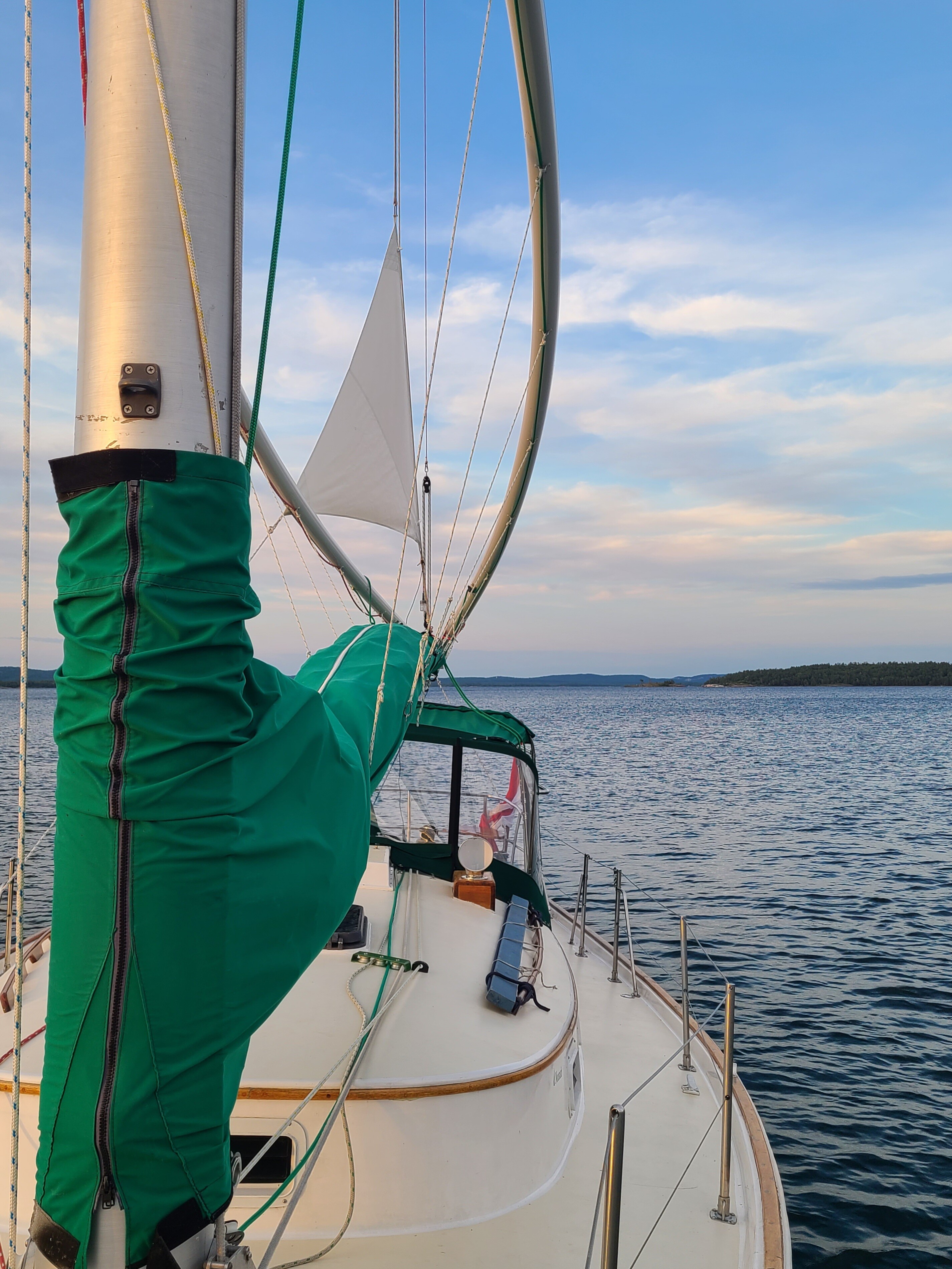
We are currently in the North Channel of Lake Huron and have had a chance to try out our new riding sail at anchor. As you likely know Nonsuches have a tendency to sail (a lot) at anchor because of all of the windage forward. The purpose of the riding sail is to much reduce this since when the boat swings to one side the wind hits the sail on that side.
June sewed the sail from a kit provided by Sail Rite on a regular domestic machine. We bought the larger of the two kits they sell and glad we did, it is not really that big. You need to be able to put two sail slides on a backstay. Our topping lift tackle is too high to use, but we have a blooper halyard that we attach to the clew fitting. We then hook the halyard to the head of the sail, with an adjustable line from the bottom of the sail to the clew fitting. The ‘sheet’ goes to a mid-deck cleat. What works best is to have the wishbone tied off to one side of the boat and the sheet go to the opposite side.
I don’t have any experience with riding sails, Thor, so I’m curious about your comment that you tie it off to the samson post.
Could someone offer a quick Riding Sails 101 explanation? I thought riding sails were typically set up at the stern to cause a bow whose bow is blowing off to fall back into line with the wind. How does tying it off to a fitting at the bow work to do that?
Don’t know the area, it is quite smalll and cut flat. It Is the larger of the two kits that Sail Rite offers, good too 36’ apparently. The instructions say you want it mounted at the maximum angle to the centre line of the boat. We figure out which side is best for exposing our solar panel on the dodger and pull the boom to one side appropriately with a line to pulpit. We lead the ’sheet’ to the mid-deck cleat on opposite side. You want both sides of the sail equally tight. You. Can achieve this by adjusting the length of the ’tack’ line.
When I bother to set it, it is as far aft as I can get it. It does make a difference. At it’s longest, I believe it’s about 4’. Maybe Bob has a Samson Post aft??
Joe Valinoti
S/V iL Gatto NS30U #221
Sea Harbour YC
Oriental, NC USA
Above, two shots of our daily use riding sail and the storm riding sail. The daily one is left up when we’re not aboard and the storm one when really bad Wx is expected, I had the dimensions from a Mark Ellis drawing and had it made by my sail maker. I’ll post dimensions if I find them or measure it myself when next aboard. I attach the clew to the back of the boom, Main halyard holds the head and the tack runs forward to the starboard howser , back to a reef winch. I use specter line purchased online used for Jeep (the car) use. Cheaper than marine grade and no issues now in 5th year of service.same for soft shackles. If any interest I’ll post links to same.
Regards, Gary Forster, Aloki NS 30329, Oyster Bay, NY.
There is another solution than the riding sail. That is to use the mast and wishboom as a wind vane by anchoring stern to the wind. I find reversing to a mooring especially effective when single handed. It is the best solution that works for me every time. The buoy is in sight all the time and much easier to pick up the mooring due to the lower freeboard aft. This may not be the traditional way to moor, but a Nonsuch is not a traditional yacht. The mast is stepped well forward of the keel so it makes an excellent weather vane and keeps the boat from sheering from side to side in a strong breeze. Try it and don’t fight the design. This solution is free!
Gary, I ditched the 130 lb wishbone a few years ago and replaced it with a 15’ 30 lb. boom. I have no regrets. (excellent forward vision, no burying the boom while rolling downwind in a following sea, stress free gybing, reduced weather helm and strain on the rudder post) In addition, the gaff sheet stabilizes the mast which should allow it to have a longer life. I am an octogenarian and made the conversion to the standing gaff rig to permit me to enjoy stress free sailing in my dotage.
Here she is being chased by a line squall. Please note that at deck level I was sailing to windward while at the masthead I was on a broad reach sailing single handed at the time. I managed to finish the race and make it to my dock before the squalls hit. My sail and I were soaked after arriving. The photo was taken by the committee boat.