Rookie Question - Choosing a slip - Bow in or Stern in?

This is my first sailboat. And that happens to be a Nonsuch 26C.

I am asked to choose a slip at the Liberty Landing Marina. I need to select a slip which will allow me and my guests to enjoy the NYC view from the ‘InnerPeace’ (when docked).

What’s easier? Bow in? Or Stern in? We have a 27 HP Westerberke engine. No bow thruster.

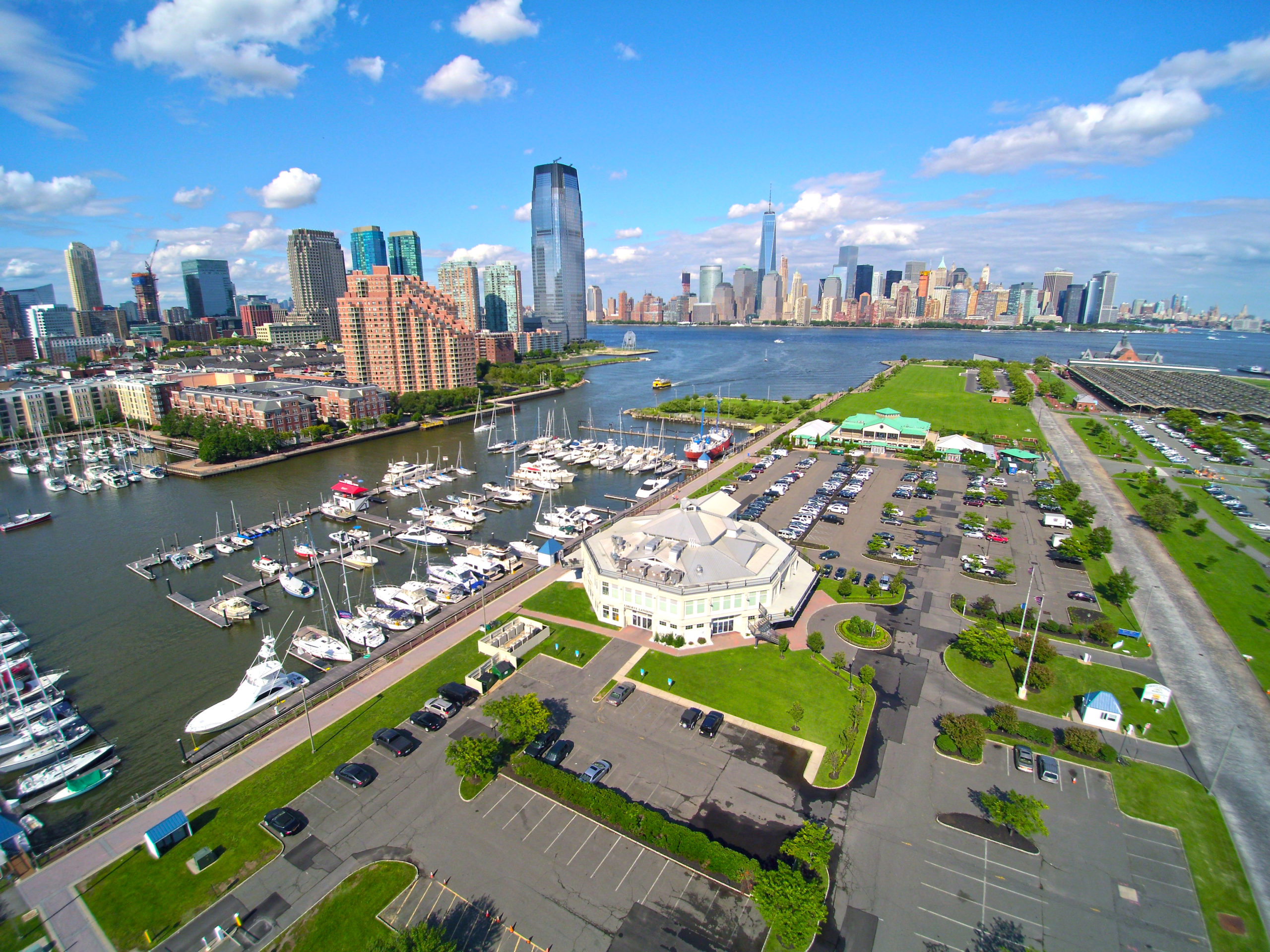
The View
Liberty Landing Marina, Hudson River, Jersey City, NJ | A Suntex Marina

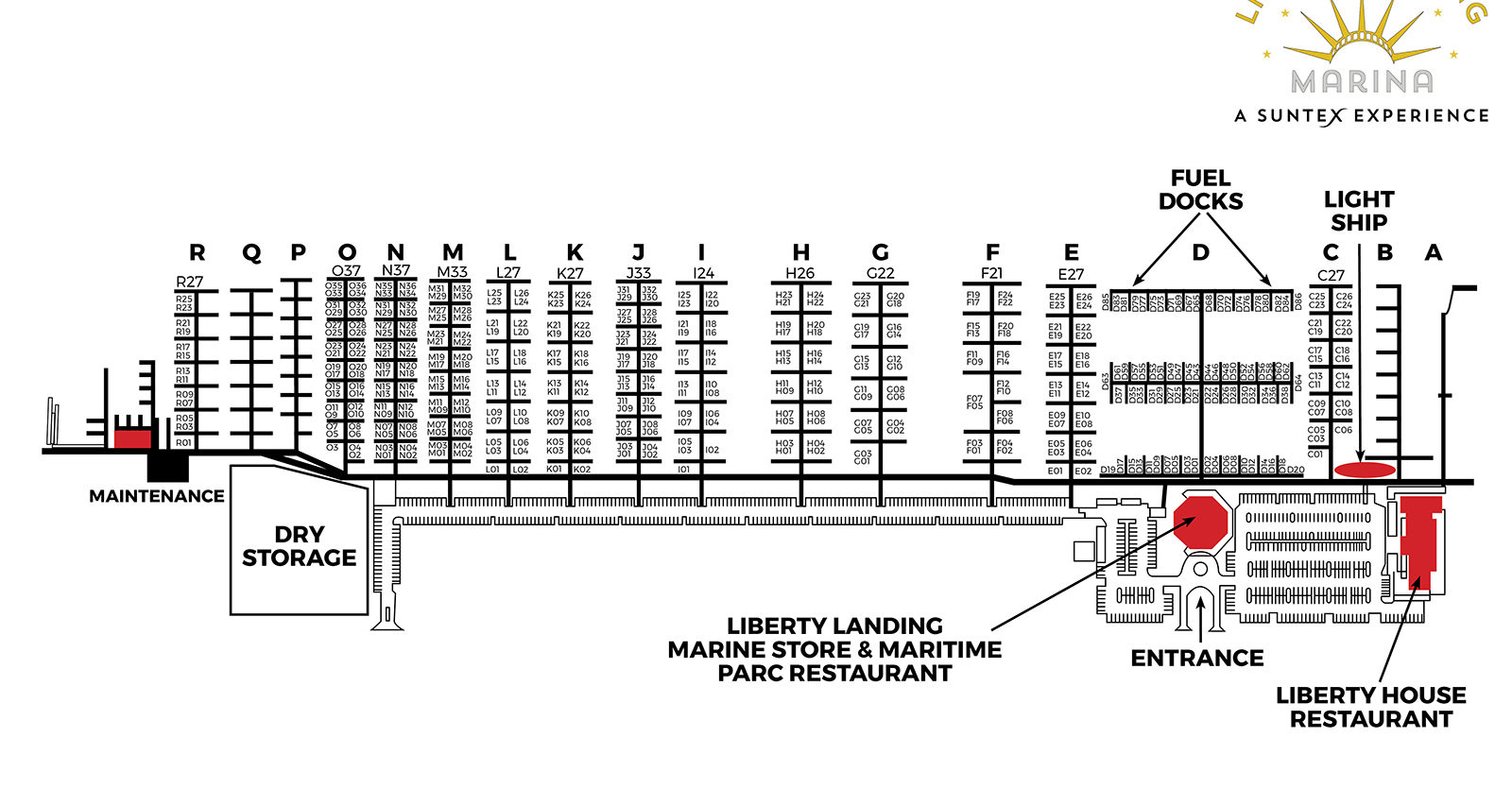
Marina Layout
Wet Slips, Transient Slips, Dry Boat Storage | Liberty Landing Marina in NJ

Thanks,

Siva Surendira
“Inner Peace”
NS26C #42
Jersey City

If you’re concerned with a view, that’s an easy decision. If you’re concerned with the best way to dock a boat, unless there is a specific reason, stern to is always better, particularly if you have tidal concerns. This way your lines can be longer to allow for the rise and fall. Also, take advantage of having that Sampson post forward and use it without your lines going through the chocks. There is a whole lot less chafe that way.
Joe Valinoti
S/V iL Gatto NS30U #221
Sea Harbour YC
Oriental, NC USA


[details="(attachments)"]

![NS30U DoradesForedeck 001.jpg|2288x1712](upload://iyeGEl0pbqTzxJiOpq89PySriW3.jpeg)
![NS30U Foredeck 004.jpg|2288x1712](upload://br6oFCuZWoz2aWdNPbn6ElEDt6k.jpeg)

[/details]

I have a 14 foot wide slip and a 12 foot beam and I always back in.
If the wind is nasty or docking at night I will pull in. We have a short finger-pier so getting off pulled in is a problem. We have a large fairway between the slips so I begin my backing well before I get to my slip avoiding the short bursts of forward and reverse required in other circumstances.
Leaving the slip is a delight.

I agree with stern to. It’s easier to back a boat in when it has controllable speed. When backing out of the slip, you have no controllable speed causing minimal steerage. I’d give up the view if necessary. Also, take a look at the length of the floating docks. They look short (might be a deceiving view) but with bow in you could have problems getting on/off the boat. Also consider your power cables and determine the effect that bow in and stern in might have on access to them.

Stern to takes a learning curve that is worth learning. Good to know under any circumstances. This is a great video that you may find helpful: Docking Techniques Seminar (youtube.com). It is long but I have watched it numerous times.

Cheers,

Butch

Butch Garren

Nonsuch 30 #196 “Whiskers II”

SIYC Slip 12

Solomons, MD

Brilliant suggestion to use the Sampson post Joe! I’m constantly fighting with chafe, I can’t believe I hadn’t ever thought about it! Thank you!

I prefer bow in simply because everyone walking along the dock can not pier directly into your salon.
It works best if your finger pier neighbors are power boats and the steps are at opposite ends.

Brian Cayer
Spirit~Wind
N30U 419
Deep River, Ct

Unlike the others, I don’t believe there’s a single right answer.

The question really depends on your marina layout and your comfort level maneuvering the boat. I’ve heard a lot of concerns about backing out of slips from people with 30’s and larger, but haven’t found it a major problem in a 26 if you don’t rev up too quickly. Where the boat tends to pull its stern over in reverse is when the skipper overcorrects for not moving fast enough and guns the engine. That said, forward does take less practice than reverse for novices.

The other factor to be aware of is that, because of the mast and sail area toward the bow, the bow tends to blow off to one side or the other when not straight into the wind.

To me, the first question to ask is whether you expect to have crew or will be single-handing. Although it’s important that crew understand the difference between themselves and a boat fender (the latter is harder to injure and cheaper to replace), once they understand their limitations, they can to a lot to help you guide a boat in or out.

A 30 is starting to get heavy, but a 26 can be very responsive to someone on pulling a line from on deck or the dock. A common departure trick is to loop a line around a dock cleat, pull on it from the deck, then let one end go and haul it in. This keeps the crew on the boat. Depending on which dock cleat you use and where they stand, you can have a lot of control for keeping the boat near the dock or for making it turn the direction you want.

If you’re single handing, you may want to consider having some docklines fixed to the dock and some fixed to the boat. I have one attached to a midships cleat that’s just the length needed to stop the boat before it rams the dock; I go bow in and have plenty of time to drop it on the dock cleat closest to the end of the finger before the boat goes too far.

Whether single-handing or with crew, if someone on the dock can start pushing the boat out before putting the engine in gear, you have some motion and rudder control. That makes it easier to use the engine gently. Again, the N26’s are a lot easier to push and pull than the bigger Nonsuches. I’m pushing 70 and have a bad back, and I can do it.

The second question to ask is about the prevailing winds in your marina.

If you can get a slip where the wind tends to blow you out of the slip, then you have the most control, coming and going. In that case, the advice about backing in may make more sense for you.

If you have a slip where the wind tends to be blowing you into the slip, then it’s more difficult for a novice. Backing in will require more control because the bow will be into the wind and will tend to blow off, although departure will be easier.

The worst case is if you’re in a crosswind slip. If only slips where the wind tends to be on the side are available, try to get one where the wind will be blowing you towards the dock rather than towards another boat. Getting pushed toward the dock only makes the above tricks for pushing the boat around slightly easier, because you can get on or off the boat more easily without.

A couple of other suggestions that might reduce stress. First, fenders placed where you might contact another boat or a piling can alleviate a lot of stress. Making contact is a no harm, no foul situation if a fender’s there. Second, if your marina will let you, get a lot of discarded firehose (my favorite source is https://www.repurposedmaterialsinc.com/hoses/?categories=fire-hose) and put it in a scallop pattern the length of your dock. Here’s a picture of mine, with a good friend posing with it. (Traffic cones are surprisingly good for discouraging sea lions from climbing on your dock, but that’s a different thread.) The scalloped fire hose will give and let your boat slide in and out without marring it. I actually use this to do my docking without any fenders.
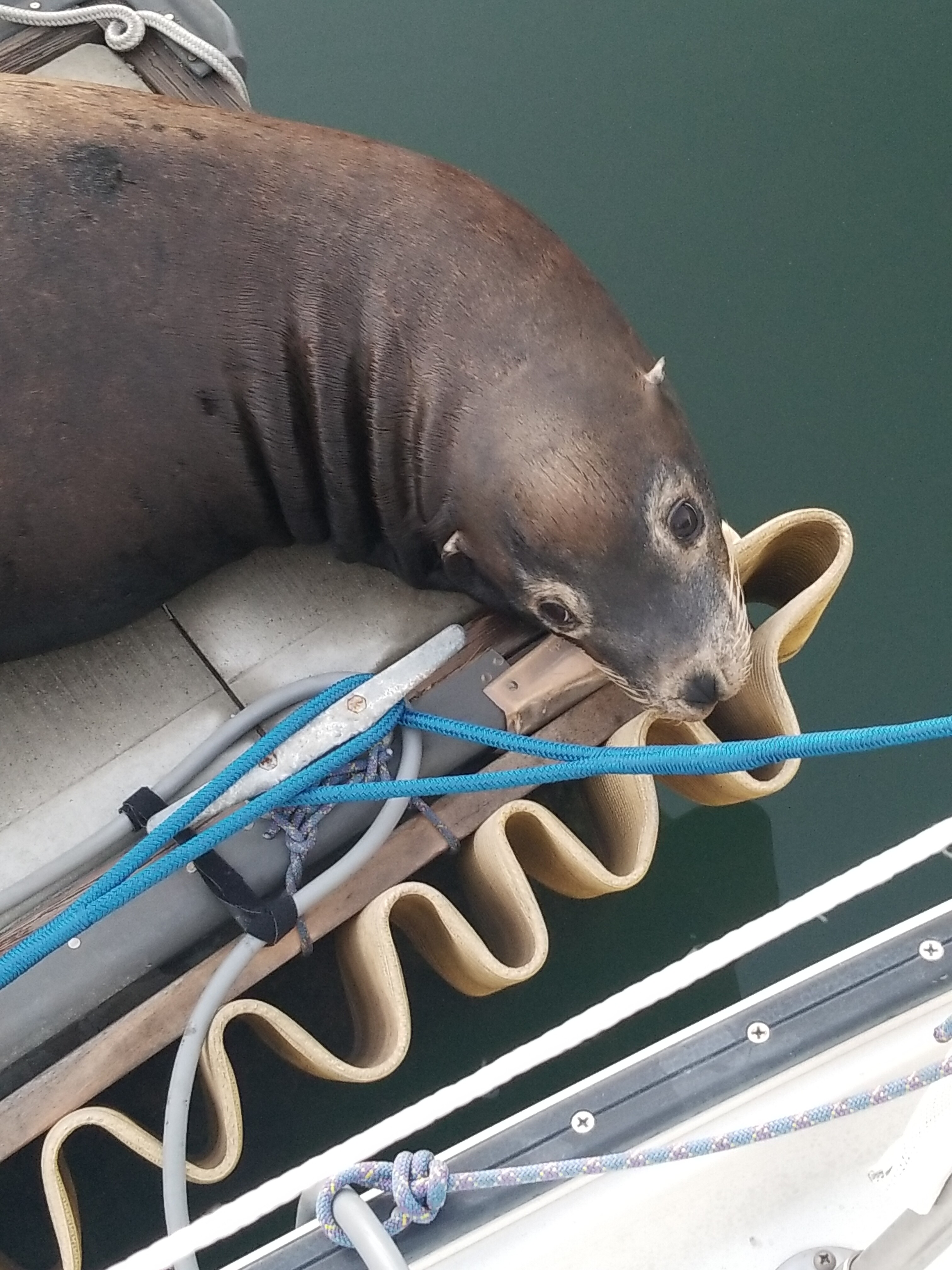
Fire hose dock fender.jpg

Last tip – don’t worry. There’s an old saying: a boat will scare people to death LONG before it kills them. Well, maybe, “The only thing we have to fear is fear itself,” might be more comforting. The point, though, is your boat is incredibly sturdy and can take a lot. Everyone in a marina either had to learn to dock themselves, or is lying about it, or is so rich that someone else does it for them (in which case, who cares about them). So, you can relax, take the time to practice and forgive yourself a few initial bumps in the night.

– Bob
Me Gusta
Nonsuch e26U #233
One of the tricks to backing a boat with prop walk, is to get the boat moving and place the shift in neutral. This stops the prop walk and allows the rudder to take over. Practice, practice, practice. If at all possible, always take advantage of the wind direction and the prop walk.

Joe Valinoti
S/V iL Gatto NS30U #221
Sea Harbour YC
Oriental, NC USA

In your case, Siva, I’d go bow-in. After a sail, you can just “drive the boat in”. Period. Safely, in one piece, at the dock. Whew … you made it !! You’ll practice and learn how. When you go for a sail, you could get assistance from someone on the dock who might “walk the boat out a bit”. This “exiting the dock” manoevre can be planned, scoped out, thought about and arranged and be all ready for you when it’s time to depart. It’s AFTER sailing around that you least want to be shouting for assistance (if required) or getting stressed out about backing the boat in if you have little or no help.

At my club in Toronto, we have over 300 sailboats, many of them 30’ or longer. At least 90% are docked bow in. Same for other local clubs. Planning for “backing up” is easier to do when you have the luxoury of being at the dock, nice and calm, assessing what assistance you have or may need, as opposed to arriving and reversing and crossing your fingers because the wind is changing, etc.

Also, I do agree with Brian Cayer - I don’t like “tout le monde” walking by on the main dock (at all hours, I might add) and peering right into my cockpit and, especially, my cabin. People are great (but not when you want or need) some solitude or, frankly, if you ain’t wearing all that much or you just woke up.

Bob Neches - that is a great shot of your “guard” seal.

Ernie A. in Toronto

Joe (as usual) is correct. Practice, practice, practice. Be patient with yourself.

Ernie A. in Toronto

We lived onboard at LLM for 18 months on our Bristol 45.5 (Dock C). Very enjoyable, the cheap winter dockage (almost) made up for the pricey summer. The bow in/stern in choice seems almost regional in nature. When we were at LLM and on Lake Ontario it was/is rare to see a sailboat stern in. With a powerboat stern in is quite common but often these have twin engines . I would suggest bow in, facing west so you can see the city from the cockpit. If you can, find out what boat you will be sharing a well with, a narrrower beam is a plus. A final thought, if you can talk to someone with the same engine and prop so you know about the prop walk. Some ‘fancier’ props, like Maxprop have little prop walk. Fixed props no have walk and you can use this to good effect. I liked to have the PW pull the stern into the dock.

Looks like I am losing this debate but let me throw in this thought. According to the provided picture and not knowing what slip is in question (maybe it’s identified and I didn’t figure it out) there would appear to be very little fairway room to maneuver a boat. I would rather drive the boat in stern to with the appropriate amount of speed. That method (with practice) would allow control till it’s parked. Of course, there is wind and current to deal with. When departing with the stern to method, I have immediate control of the boat with the appropriate amount of speed and just drive her out. Our club uses pilings rather than floating docks. In the case of error in judgement the pilings become very good friends. In the case of this boat and this marina/club I picture this boat backing out slowly into wind, current or both with no speed and would appear to have little control. If driving her out, with the stern in position, in the same fairway condition I would think there is immediate control to deal with the elements.

As an aside, I do know that if I moved Whiskers to a floating dock environment that I would need to spend a lot of time practicing and learning how to deal with those cleats and/or pick up lines. What the hell, I’m still young (almost 83) and I can learn these things.

No matter what method is chosen, Joe has the appropriate words “PRACTICE, PRACTICE & PRACTICE” and that doesn’t mean only once or twice.

Regarding a NYC view, after you choose your chosen parking method I would get a slip assignment (if possible) that satisfies the view thing.

Cheers,

Butch

Butch Garren

Nonsuch 30 #196 “Whiskers II”

SIYC Slip 12

Solomons, MD

(attachments)

~WRD2201.jpg

This time of year, the slip usually chooses you… meaning the folks who know the marina ( and the local weather & depth ) have already reserved the primo spots. Chances are, to get a optimal view you will need to build your maneuvering skills. Not a bad thing to have to face the wrong way till you are comfortable docking stern to. Gives you motive to learn.

Also, the marina will probably tell you which dock(s) and slips are both available and matched to your boat. The choice is usually easier than you might think given the marina constraints.

This is our first season with Soave and the slip we landed ( B5 - HERE ) in isn’t the easiest for a new boat, but we’ll manage. The thing that makes the most difference is to know your neighbors and always stand ready to help them in difficult conditions my experience is they will reciprocate. Also help from dockhands is sometimes available. I don’t know much about marinas in urban locations, but I’d think to keep the peace they would be eager to assist with docking.

Next priority, learn the boat. A good framework for practice is provided in ( Manoeuvring: At Close Quarters Under Power ). After you learn one approach, stop using it and learn a new one. It’s painful to watch folks use the wrong approach for the conditions just cause it’s the one they know.

Rob Cohen
s/v SOAVE
NS33 #009
Westport, CT

I’ve had dockhands ruin more then one approach. Some marinas require bow in only because it’s easier for them to adjust bow lines. Sometimes, they can’t even tie a cleat hitch.

Joe Valinoti
S/V iL Gatto NS30U #221
Sea Harbour YC
Oriental, NC USA

I think Bob makes some great points - i.e. don’t discount the wind factor and how it affects the bow much more than the stern. If the prevailing winds are going to push your bow sideways where you don’t want it to go, either docking or departing, I would want to back up into that wind. This is especially true if you are a crew of only one or two and can’t manipulate spring lines and fenders.

Ken Julian
“Blue Note” NS26C#9
Fredericton, NB

Hi Siva,

LLM - if you want the NYC skyline view from your cockpit - bow needs to face west. Also keeps your cockpit away from people traffic as noted in other responses.
My unscientific observation is that most boats that go stern-in do so because their shore-power connection is near the stern of their boats.

For my Nonsuch 30 I prefer bow in, port-side tie-up because even after 37 years I still whack my shin occasionally on the mainsheet winch when going in/out of the cockpit on the starboard side - but I am apparently a very slow learner… no winch on the port-side.

A few years ago I moved from the west side (odd numbered slips) of N dock to the east side (even numbered slips) of N dock for a few reasons -
a) my prop-walk (I have a Kiwi Feathering prop, prop-walk not as strong as it is with a fixed prop) pulls to port when backing down (it is a right-hand prop, so in reverse it pulls to port). If backing out of a slip on the west side of the dock, pulling to port puts your stern toward Morris Canal (the main waterway to get in and out of the marina). On the east side of the dock, prop-walk to port puts the bow pointed toward Morris Canal… much easier.
b) with a bow-in, port-side tie-up on an east-side slip, I find it easier to dock as you can point your bow at your finger-dock, between the outermost and mid-dock cleats and will make it into the slip easily almost every time (adjusting as you need to of course!).
c) the view was not of the skyline, though the sunsets are fantastic.

d) I do not have shore-power so that connection has never been a factor in my decisions

Peter Grabow
S/V CAKE WALK III
1987 30U 430
Jersey City, NJ

Bob - lots of great advice in your email.

One I have to comment on: Leaving a slip in reverse:

Hi Siva,

First of all, congratulations on your new boat. I think you’re going to love her. I got my first sailboat about 2 years ago, a Nonsuch 22, and have just moved up to a NS 26C. I had lots of fun and made lots of mistakes learning to sail the 22. So far I’ve always docked “bow in”, but am hoping to learn to back my new boat into her slip. It’s a tight slip on an angle, so I’ll have my work cut out for me. You have an amazing view at your marina and it looks like you’ll have some view no matter which way you dock her. As for bow in or stern in, you can always change that, can’t you?

Elsie Sands
NS26C #60 Seven Stars
Maple Bay, BC

Why when 90% of sailboats tie bow in do they put shore power at the aft end… Never understood that.

Only argument for bow in , better visibility when leaving the slip..

Backing in takes a bit more practice and a lot more speed. Because our slip faces NE we try to even out the sun damage port and starboard by alternating every other year. The years when we go bow in are always a lot easier for the actual docking, but running the power cord all the way aft is a pain that sort of evens things out.

Tim in STL
White O’morn NS e26U #216
Harbor Point Yacht Club
West Alton, MO