
Peter Farley
Knot in a hurry 1986 u 328
Keyport NJ.
My muffler started leaking around the weld at the base. It has a 2 inch input and 1 1/2 inch output looks like it could have original but that would be an amazing amount of time to be in service. I got a replacement from defender but it is almost twice the size. The new one is fiberglass with 2 inch ports on both sides. I also had to buy an adapter for 2 inch to 1 1/2 inch for the output. Has anyone else had and luck finding a stainless replacement?
Hi Peter,
This one seems to look a lot like your old one:
https://moyermarine.com/product/stainless-steel-water-lift-muffler-exht_01-0_377/
But I also wonder if your old one could be re-welded. Welds in stainless steel are likely to rust out faster than the original metal, so maybe the rest of yours is OK?
Looked at that one it appears close but the inlet and outlet are backwards, From the description.
The inlet is designed to accept a 1-5/8″ ID exhaust hose, which will conform to the OD of a hot section constructed of standard 1-1/4″ pipe fittings. The outlet is dimensioned to accept 2″ ID exhaust hose.
If the outlet is smaller than the inlet, wouldn’t that increase backpressure and rob engine power?
Peter, if you haven tried Centek yet, I suggest you give them a call. I have replaced the stainless muffler with a fibreglass Cenek and have been very happy. Genera the fibreglass does better with salt water. Centek will help you get the correct muffler for application.
Mark Powers
Absolutely use a fiberglass waterlift muffler!! I ran the local Rotary Club’s nautical flea market last week, and I had several for sale at $5 ea. One of them looked exactly like the one on my W-27. If it wasn’t buried in the club’s storage trailer, I’d grab it for you.
Joe Valinoti
S/V iL Gatto NS30U #221
Sea Harbour YC
Oriental, NC USA
5 bucks!!! I just paid $336 and another $50 for the adapter. Oh well it is going in today.
I agree but that is what is there now. The mixing elbow is 2 inches and I want no part of trying to take that apart until I have no choice. The thru hull for the exhaust is 1 1/2 and that matches the scupper drain on the other side. They appear to be original. I also don’t want to try and run 2 inch hose through the boat. it is amazing how much harder it is to work with verses the 1 1/2.
We run an in-water boat show here every spring and people donate items for us to sell and is why everything is cheap. Come down next year.
Joe Valinoti
S/V iL Gatto NS30U #221
Sea Harbour YC
Oriental, NC USA
I’m curious. Is this a SHYC or community kind of boat show and sale or is the sale a part of a commercial boat show with dealers and brokers and such? I ask because a commercial boat show is being held in our marina this June. If it goes well there is a 2nd hand boat supply outfit in town and I might put the bug in the management’s ear to include them next time. But I’d be interested to know what works well elsewhere.
Stainless is not widely used in wet exhaust mufflers today. They develop pin hole leaks over time at the welds. Plain 316 stainless is not great for exhausts, you apparently need 316L.
I removed my leaking 40 year old system and replaced it with a Vetus . Centek is another make similar to what was installed in our boats. And if the muffler is gone the injection elbow is not far behind.
My 40 year old set up was 2 inches ID from the engine ( Westerbeke 21) to the exhaust , 1.5 ID from the exhaust to about a foot from the exit where it was 2 ID again … odd to say the least. Anyway now 2 inches all the way and engines seems to like it. Less of a pop sound and the water flow is more uniform. It was well past it useful life.
Removing the exhaust line was a task but heat and penetrating oil won the day.
I had to remove it at the coolant tank as the exhaust flange was seized along the studs and I needed the flange to be oriented vertically to get the penetrating oil into the studs.. Fortunately I had had the tank out many years ago and used copious amounts of anti seize.
One mistake Westerbeke made was not to applying the anti seize along the entire stud as the shaft of the stud over time rusted to the flange. That was the issue with the exhaust flange . It took several days of heating and cooling with copious amounts of penetrating oil to break the flanges apart to remove the exhaust . I used a penetrating oil that “freezes” and combined with a propane torch it finally separated. I did have to go to MacMaster Carr for new studs as the 1/4" size for the coolant tank are not carried in places like NAPA. I slathered a high temp anti seize everywhere.
The dry exhaust section was actually ok. Schedule 40 iron pipe, but cheap to replace. The injection elbow was finished. after 40 years on the Great Lakes and 3 in salt water. Westerbeke sells a iron injection elbow and fittings for $400. However I got a stainless injection elbow from www.tadiesels.com For $415, it’s 316L not 316 so should last . It is about twice the thickness of the Westerbeke one.
Diane Boothe
Trans Atlantic Diesels, Inc.
(T) 804-642-9296
(F) 804-642-0340
Just the stainless part shown.
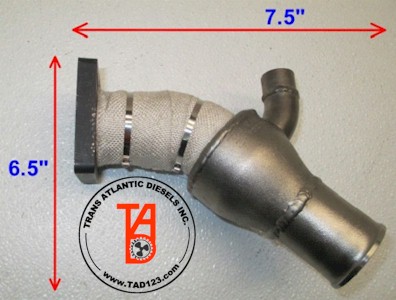
I could have cut the schedule 40 pipe section and then removed the nipple from the flange by cutting. But I was not entirely convinced that would be easy or advisable given the access I had and assembling the exhaust would have been difficult .