We are in smelling distance of being ready to publish the “Quick Guide for New Nonsuch Owners” that some dozen of us have been working on for a year.
One of the things we’re missing to finish it off is a good picture of a properly lashed sail clew.
If anyone who has rigged their sail with a lashing between the clew and the tail end of the wishbone has a good high-quality picture of it, would you please email it to INA@nonsuch.org?
Thanks,
– Bob
Robert Neches
Co-President, International Nonsuch Association
Me Gusta, Nonsuch 26U #233
(with a lashed clew, but not done the conventional way we’d like to show in the guide)
Bob,
I already have the recent publication of the compilation you posted on the INA group recently. This sounds like this will be more than that excellent document, is that so?
Brian
Boat-less in New England
Hi Bob, here are a couple of pictures for you to consider.
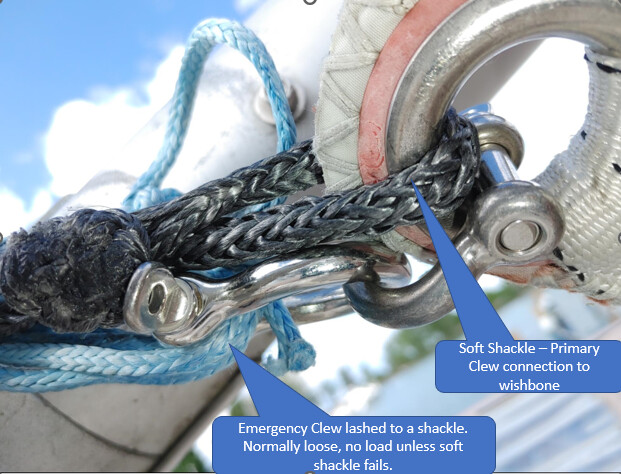
I use a commercially available soft shackle as the primary link between the clew and the wishbone. This started out as an experiment and has worked well for me for a couple of seasons.
Because it was an experiment, I backed up the soft shackle with a secondary lashed piece of spectra (30 cm) that is normally loose and would only take up load if the soft shackle failed. It also means that in an emergency I might need to cut through two lines rather than one. The picture also shows a third line with a snap shackle. I use that to attach the aft end of the sail cover when not using the sail. I will probably dispense with the backup next season; I now trust the soft shackle.
I am interested in thoughts and critique of my system from others even if you choose not to use the pictures.
Hi,
I only have a soft shackle, wrapped twice around the clew so as to maximize the outhaul effect of the choker. I actually got it wrapped three times around the clew, but that was after this photo was taken, and sail is now off the boat for the winter.
There are no dumb questions, John - it’s a good question.
Either Mark Ellis (who designed our boats) or Ed Botterill (who “designed” the sail) or BOTH called for the sail to be lashed. Lashing the sail allows the clew to twist and roll and move freely without being limited in movement. It also allows one to obtain the distance that they desire between the clew of the sail and the inner end of the boom.
And … as it’s HUGE sail, a lash allows one to cut the lash line instantly in case of a problem. Like you, I started out with a shackle on my little NS22. One day, in a blow, the shackle gave up and … bang … flap flap flap. I, then, decided a lashing of Dyneema was safer and better and … only later on … did I discover that a lash was the preferred MO.
Hi Bob, here are a couple of pictures for you to consider.
I use a commercially available soft shackle as the primary link between the clew and the wishbone. This started out as an experiment and has worked well for me for a couple of seasons.
Because it was an experiment, I backed up the soft shackle with a secondary lashed piece of spectra (30 cm) that is normally loose and would only take up load if the soft shackle failed. It also means that in an emergency I might need to cut through two lines rather than one. The picture also shows a third line with a snap shackle. I use that to attach the aft end of the sail cover when not using the sail. I will probably dispense with the backup next season; I now trust the soft shackle.
I am interested in thoughts and critique of my system from others even if you choose not to use the pictures.
I am not really sure that I should jump into this issue – however here goes.
Just recently asked by John Vincent = why lash instead of shackle
I myself feel that this idea of lashing should not even be considered – have all of you supporting this lashing idea - tried to hold the wishbone steady in any kind of a sea condition- and standing up without assistance to enable you -to cut your lashing
Next time you are out in a slight sea way - try
I am sure the answer is it can’t be done- hold the wishbone steady. And you standing up to cut. Also please Google “ Cutting Dyneema” for some guidance on cutting - that advice comes in with my experience of working with such material.
My next question is Do all of you “Lashers’ have knife/ or some kind of cutter strapped to the binnacle ? ready for use to tackle this impossible task!!
I have never heard/ seen/ sailed with/ any serious cruisers/ racers work with anything but the clew being shackled.
This idea of lashing should not be part of any advice to would be / New owners
Our “Blog” certainly has posted several good suggestions in the past but this is certainly not sage advice.
I (and, likely, most other members of this group) are open to change and Cedric makes good points. Still, I would like to know that IF I had to, I could seperate the clew from the boom.
But … did anyone really insist that the line had to be Dyneema or Spectra ?? Probably not. If the philosophy leans toward “if in real trouble, cut the line” (as in: keep boltcutters handy to cut the standing rigging on a “rigged” mast) … well, Cedric makes a good point. The line should not be Spectra (it should be easily “cutable”) and, yes, a good knife should be handy, in a safe place. If the line is conventional rope, it should be part of our checklists to, indeed, check it for fraying, etc., from time to time. Just like the choker lines and tackle.
True, I would not like to be flailing around, trying to grab the end of the boom, etc. Another very good point. But, if you need to … at least, you can try (without going into the drink).
This needs further comment and thought and I welcome the opinions of other more experienced Nonsuchers (and, just maybe, the voice of anyone who had to go through this exercise of cutting the lashing).
It is snowing up here in Toronto - how absolutely horrible. Arrrrghhhhh !!!
I feel we are getting into a “which is the best anchor” conversation and not necessarily bad to have a divergence of view (you pays yer money and you makes yer choice) but - even as a newbie - I respectfully disagree.
Yes I’m sure it’s going to be difficult under the circumstances you describe. I think getting a shackle off is going to be even more challenging.
So on a risk reward basis I would go with the soft shackle/lashing idea. I’ve done it now for two seasons and have gone the same route on the chocker.
And yes I do have my sailing knife strapped to my belt. And there is a second one in the cabin - no real need for two except like my glasses the one I’m trying to find before going sailing is always somewhere else. As someone else said recently, cheap insurance.
Best regards
Neil Raynor
NS26C #149
Collins Bay, Kingston
(although today under our first snow fall in Ottawa)
The other reason for using a soft shackle or lash is wear and tear. SaSeaCat’s previous owner(s) used SS shackles to attach the clew to the wishbone. The result was the hole for the clew in the aluminum casting on SaSeaCat was worn into an oval to the point I was concerned about its integrity. Mike Quill sold us a repair kit.
A soft shackle allows the sail to move without wearing the casting or the clew ring. Of course, inspecting the soft shackle periodically is a good practice. I have used the same shackle for two seasons now, no sign of wear. And yes, I keep a knife at the binnacle. But I take Cedric’s point, my attempt to cut the shackle in rough conditions would likely result in my amputating my other hand immediately before immersing myself in Lake Huron.
I’m doing some winter ordering today and was consulting the 26C manual on other stuff. Although I’ve heard reference to Hinterhoeller recommending that the clew be “lashed” to the end of the Wishbone I hadn’t seen it in writing.
But when I opened my book there it was in the 26C Sail Plan & Specs. (Attached)
Moreover, when I looked in the 26U book it has the same comment ("Clew: Lashed to end of wishbone”) on pg. 41.1 (Sail Plan Specs).
Chester puts up a good argument but, I believe lashing is the way to go. I use webbing as my lashing preference as it is strong and easy to cut. Of course there is a cutter nearby. I keep one in my propane locker. I know that nothing else should go in the propane locker but I have chosen to put a sharp knife in there along with my emergency whistle and a flash light.
A previous incident where a crew member drove the boat into a day marker causing the sail to wrap around the marker with a wind blowing us against the marker. Please don’t send me hate mail because of this as I know I was the captain and that should not have happened. There was an immediate need to remove sail but the first obstacle was the tack shackle. It was the screw pin type with a wire to keep the pin on. A tool was needed to get the wire off and then found that the pin was frozen to the main body of the shackle. This required another trip to the tool box to get a pair of pliers. I already had strapping on the clew and that just took a flashing second in time to cut.
Now, both the clew and the tack are lashed on.
I am not sure why the use of lashing is of concern as it accomplishes exactly what hardware does except that it is easier to remove.
Regarding the awkwardness of working at the end of the wishbone, is not it the same effort or more to remove a shackle as it is to cut a lashing? Just sayin…….
On the 22 I used 4mm dyneema, wrapped 4 times, adjusted for length, then tied off with 10 or so hitches. I think on the larger boats, 6mm would be fine. Not sure if this image will work for you. You can crop and edit as required.
When I bought Mistoffelees the previous owner had used a steel shackle to attach the clew to the wishbone. Besides discovering the wear it was creating on the sides of the wishbone, more important to me was that it was bringing the sail to far back causing the roach to constantly hang up on the topping lift line. When I used lashing to created more distance between the clew and the stern end of the wishbone, I also had to adjust the front pennant choker line where it attaches to the pad eye on the mast by a ratio of 2:1. Thankfully the length of the foot on my sail was just right so that with full choker pulled on there was still room enough between the mast & the forward end of the wishbone.
Herb G. Huber, Mistoffelees 30C#91, Bridgeview Marina, Point Edward/Sarnia, Ontario
Lake Huron Nonsuch Association